Quantcast
Channel: Fierce, Freethinking Fatties » Themeless Thursday
Viewing all 88 articles
Browse latest View live

Honey, you know I support you … Part Two

$
0
0

My Boring-Ass LifeFat Fashion

I wrote Part One a while back, before I went to the con, but as publication schedules go, the “I’m going and I don’t care what anybody says” post and the “I went and I have a couple of pictures!” post are coming out on the same week.

To reprise:  I decided to cosplay Lara Croft at my local sci fi convention. My husband and friends were a little worried that somebody would be rude. I was determined to do this anyway.

Okay, now that I’ve caught everybody up…

After we checked in and received the program book, I looked in it for the con’s rules about harassment. This con has a very well-written definition of what constitutes harassment (any unwanted attention, and that includes people taking pictures of others without their consent). It also has a very well-written guide on what to do when one is being harassed, as well as the steps to take to report harassment. The consequences (which includes steps from the harasser being told to leave the harassee alone all the way up to getting hotel security and/or police involved, if necessary) are also described. In all, I was very happy to see the comprehensive rules on harassment.

I showed that section to Conall to relieve his mind.

Saturday, I was up early. I was nervous and excited, all at once. I dressed, and Conall and I went down to the hotel restaurant for breakfast.

Me, in the hotel room, before breakfast

Me, in the hotel room, before breakfast. Taken on my cell phone and so is a bit blurry. But then, before some sort of caffeine, I’m usually kind of blurry anyway.

It was as we were walking down to breakfast I found a problem with the holster — it clipped on tightly, but then the thigh strap above the knee loosened up as I walked, and felt like it was trying to fall off. Grrr. Costume malfunctions! So, after breakfast we went back up to the room, and I fixed the holster so it wouldn’t do that as much. I am a lace maker, and so always go places with scissors and thread, and was able to make the holster work. And if needle, thread, and scissors didn’t make it work, well, I never leave home without duck tape!

On the Mezzanine

On the Mezzanine

As you can see, the thigh strap is a little wonky, but not as bad as it had been.

I was recognized as Lara Croft a few times during the day, so my worries of nobody getting who I was trying for were for nothing. And I found I really like the backpack purse. It held everything! My Kindle, the candy I was having friend beta test for me (err, why yes, doesn’t everybody get their friends to beta test a new product at a sci fi con?), my wallet with ID, my camera, and even purchases from the vendors room. I’m seriously going to look into using that thing more often. Because, yeah, that can carry a LOT of items!

But I digress.

Not one person harassed me all day. Matter of fact, many people were complimentary to me. And it was awesome that people who didn’t know me knew that I was Lara Croft.

Next year, I want to be Buttercup (from the Power Puff Girls). Or maybe a character from The Desert Spear, Book Two of The Demon Cycle Series by Peter V. Brett. Or maybe…

Voguing for the camera

Voguing for the camera

My friend told me to pose. So, me, being the silly person I am, decided to go all Madonna. Yeah, I know. That’s not canon!


Filed under: FF, MBL, Themeless Thursday

Plus-Size Halloween Costume Review

$
0
0

Fat FashionMy Boring-Ass Life

Last Saturday night, I went to a Halloween dance called “The Monster Ball.” It was a fundraiser to provide Christmas lights and decorations for my town. Costumes were optional, but I decided to dress up this year since quite a few people who attend do wear costumes. But when you’re deathfat, the options for costumes, especially ones above size 3X,  are pretty scarce unless you have sewing ability, of which I have zilch.

So I had to do some serious thinking about what to dress up as and I ultimately decided to be a 50s bobby soxer since I thought finding a plus-size poodle skirt wouldn’t be that difficult opposed to other outfits, and it would not only be comfortable, but cute. Being a sexy “whatever” isn’t my thing. I’m not downing the ladies who want to wear something that shows off the curves, but when I go to a Halloween dance, I actually dance and I need something that’s easy to move around in.

After figuring out my costume budget and searching some websites, I found an online retailer called The 50′s Hip Hop Shop, which is also located on Etsy. They are seamstresses from Utah who sew poodle skirts by hand and they make sizes in 3X/4X. Poodle skirts are elastic waist, so I figured I’d have no problem fitting into one.

The skirts came in a variety of colors, but I decided on a black skirt with a hot pink poodle since I had a short-sleeved black polo shirt I was planning to pair with it. And the website was offering poodle skirt kits in different price ranges. The more expensive kits sold the poodle skirt, poodle polo shirt and all the required accessories (scarf, cat eye glasses, white poodle polo shirt, cinch belt, saddle shoes and crinoline slip). I decided to order the four-piece outfit, which consisted of the skirt, scarf, glasses, and socks, for $43.99. I also bought the cinch belt in 3X/4X, which was on clearance for $1.98, luckily, and the slip for $39.99. For under $100, I had a costume and I stayed within my budget.

The waist size on the poodle skirt in a 3X/4X is 42-52 and the length 24 inches. The waist size on the slip was 38-52, which is pretty generous. I got all the items in time for my dance and the skirt and slip fit perfectly. The skirt was made of felt and was good quality. The socks also fit, which was a nice surprise considering my shoe size is a 12 WW to a 13 W and the socks fit up to a size 10 shoe.

But the most important part… how did this deathfatty look? Pretty darn good I’d say!

Bree's Halloween Costume

Ready to rock around the clock!

I’m also wearing a wig, borrowed from my mom, and a black rhinestone-studded headband, which you can’t see that well. I also added pink poodle earrings and a stretchy bracelet with a record charm I bought at Spirit Halloween. The white sneakers I found at Lane Bryant and, even better, they were on sale!

Here’s a close-up pic of me where you can see the wig and cat eye glasses more clearly:

Selfie

Hello gorgeous!

Although I got a lot of compliments on my costume, sadly the judges weren’t feeling the 50s spirit that night, so I came home empty-handed. But I had a great time, did a lot of dancing and we probably raised a few thousand dollars to light up the city this December.

I would definitely recommend The 50′s Hip Hop Shop to fat ladies looking for a Halloween costume or if they need something for a 50s-themed event. The skirt fit nicely and there was some extra room in the waist, so a woman who weighs 400 lbs., or a little over, can fit into it. I’m 5’9″ and hover around 360-370 lbs. The slip was true to size, but again, I think if you’re on the verge of a 4X/5X, it will fit you. They also have a Facebook page where they encourage you to post pictures of yourself in their outfits. I did, and thanked them for “thinking of the big girls.” They replied back and said I looked fabulous.

So whatever your plans are for Halloween, I hope you have a great holiday and happy hauntings!


Filed under: FF, MBL, Themeless Thursday

Ends and Means —

$
0
0

Weight LossMy Boring-Ass LifeDiet Talk

As a father, I sometimes find myself reminiscing to them on the history of video games like my grandparents reminisce on the dawn of the automobile. Born in 1979, I grew up in the sweet spot of gaming history, when the first in-home consoles arrived. The Atari 2600 came out in 1977, but our parents didn’t give in to the video game fad until after Atari’s first competitor, Intellivision, debuted in 1980.

Intellivision-Console-Set

This was state of the art in 1983.

Sewer Sam

Talk about a shitty game…

When I was their age, I played Pitfall, Burger Time, Advanced Dungeons and Dragons, and Night Stalker (all of those links go to video demonstrations, for the young’uns). I remember the excitement when I received my very first video game present, Sewer Sam, about a guy who seems to enjoy running through raw sewage dodging bats and rats.

Then came the very first Nintendo Entertainment System (NES) and the very first Super Mario Brothers game in 1985, when I was in kindergarten. It was a revolution in gaming that set the bar for all future consoles. Nintendo also introduced us to some of the most beloved game franchises of all time: Legend of Zelda, Metroid, Mega Man, Metal Gear, Castlevania, Kirby, and Tetris.

I remember playing the first Mario Brothers game and thinking how cool it would be if there was a video game where you could “live” in a city and do all the things grown ups could do, like driving cars or flying airplanes. But that kind of game wouldn’t be possible for over a decade, when the hardware could catch up to the ambition.

In the meantime, NES got its first real competitor, the Sega Genesis (1989). Nintendo responded shortly thereafter with the Super Nintendo (1991). Our family skipped those versions, but I was able to get the Nintendo 64 (1996), whose chief rival was the Sony Playstation (1994), which made a big splash. By the time the child-friendly Nintendo Game Cube (2001) came out, I was too mature for that, so I became more interested in both the Playstation 2 (2000) and the new Microsoft Xbox (2001). But there was one game that I was more excited about than any other and it became the main reason why my girlfriend (now wife) Cady got me a PS2 in 2004.

Grand Theft Auto.

I learned about GTA when I was working for a company that supported developmentally disabled adults who lived on their own. The two guys I supported, Dave and DJ (names changed) lived in a house and DJ had an awesome video game set-up, including Grand Theft Auto: Vice City, the fourth in the series. And we’d take turns playing it while I was hanging out with them.

Vice City

Reliving the 1980s as a violent gangster.

This was the game I had dreamed of as a child, except I didn’t just get to drive and fly, I also got to carry an arsenal of weapons and outrun the cops. Vice City’s mature subject matter became popular media fodder as parents caught wind of the fact that you could both solicit and kill prostitutes. Since then, each subsequent version has been criticized for its mature content by concerned groups.

Grand Theft Auto: San Andreas, the version that followed Vice City, raised an even bigger ruckus when a player created a modified patch that allowed computer gamers to simulate sex with the characters. Rockstar, which produces the games, pulled San Andreas from the shelves in 2005 in order to give the game a mature rating.

Ironically, the most recent version, GTA V, is even more sexually explicit than any previous version. In fact, one of the early missions has you helping a paparazzo take pictures of a starlet being… er… serviced from behind. You can also visit prostitutes and watch your character have sex in a car, as well as visit a strip club with topless, non-pixelated dancers.

Everything terrible you’ve heard about the GTA franchise is true: it’s violent, sexist, graphically sexual, and should not be played by children under the age of 18, IMHO. When I’ve heard that a 12-, 13-, 14-year-old kid has played GTA, I shudder and cringe at the messages being poured into that kid’s mind.

So, why do I still play it? Because there isn’t a game out there that can compare to its open world, simulated reality.

I first came across the GTA franchise in college, when I found the game on one of our dorm’s community computers. Grand Theft Auto II was an overhead game that looked like other games, but it took place in the city. It didn’t look or feel realistic in the least, but it was still pretty fun.

GTA 2

Bodies strewn like bird seed.

Compare that to the last version, Grand Theft Auto IV (which is actually the sixth in the series), which is so realistic that when you are driving and you run into a wall or another car or a person, you almost get the actual, physical sensation of a two-ton vehicle hitting something abruptly. The physics of GTA IV was almost too real, making driving far more difficult than previous versions. Recklessness had far more dire consequences on the driver, Nico Bellic. If you hit a car going top speed, Nico was almost certain to shoot through the windshield and into traffic.

Another testament to GTA’s firm grip on reality is that when you climb to the top of a building and base jump from the top, your stomach drops with an intensity that seems far greater than you should be expected from a video game.

With the most recent installment, Grand Theft Auto V, the physics of the game don’t feel quite as “heavy” as GTA IV, but the world that Rockstar created with this version is so vast and so complex that it dwarfs every previous version and gives reality a run for its money.

For instance, when my character, Trevor, blocks traffic to take a selfie, this is what you get.

The Finger

This guy has no idea who he’s flipping off.

The story revolves around Trevor and two other characters, Franklin and Michael, all of which you can play as.

GTA-V-Franklin_and_Lamar

Lamar and Franklin giving each other shit.

Franklin is an ambitious guy working for a shady car dealer who has him repossessing cars from people who took out shitty loans. In an early mission, Franklin sneaks through a really nice house to get to the garage and repo a teenager’s car, but when he gets out on the street, the teen’s dad, Michael, forces Franklin to take him to see the dealer. And by “see the dealer” I mean drive the car through the dealership window.

Michael

Michael is a very bad man.

Franklin thinks Michael might be able to help him find better work than repo, and takes Michael up on his off-hand offer to talk to him later. Michael is a former bank robber who survived a heist gone wrong with his friend, Trevor, a psychotic, ruthless killer. When the heist went bad, Michael made a deal with a corrupt FIB agent (GTA’s version of the FBI) to go in witness protection for a slice of the take. Since then, Michael’s family had relocated to Los Santos, where he basically watches TV or lays by the pool all day, while his wife cheats on him with the tennis coach and yoga instructor.

You’ll have to play the game to find out why, but Michael and Franklin begin a life of crime together, using Michael’s experience and Franklin’s ambition. But one particular heist got enough attention that Trevor figured out that Michael was still alive. Trevor, who lives in Sandy Shores, which is way the hell across the state of San Andreas. The map of GTA V is enormous, comparable to the size of most of San Francisco, Manhattan and Toronto (home of Chris Farley character, Rob Ford).

And the attention to detail is amazing. From the way the sea plants wave at the bottom of the ocean to the changing phases of the moon, Rockstar has gone to obsessive lengths to make GTA V a virtual reality where you can drive like a moron, get in fist fights with weightlifters (I’m looking at you FCJ), and jump of a mountain with zero consequences. It is an amazing achievement and will go down as one of the greatest video games of all time, I’m certain. Not only because of everything I’ve mentioned or the amazing story-telling… there’s also this:

Mural

The greatest video game mystery of all time.

This is a mural prominently displayed in the cable car shelter at the top of Mount Chiliad, the tallest point in the game without leaving the ground. In the bottom three squares, there is a UFO, a cracked egg and what is obviously a jetpack. In GTA: San Andreas, there was a jetpack and it was fucking amazing. But if there is a jetpack in GTA V, nobody has actually found it. There are a bunch of clues that suggest there’s a mystery to be solved and thousands of people trying to solve it, but after nearly two months, nobody has figured out what the hell this map actually means.

As Ed Grimley would say, it’s all very exciting, I must say.

In any case, at this point in the post, if you’re still with me, then you are probably asking yourself “Why the hell is Shannon telling us about this damned video game?”

Well, it felt like GTA V had more fat-related content than previous games. In San Andreas, the main character, CJ, would get fat if he ate Cluckin’ Bell or Burger Shot too much, which slowed him down some. And as I wrote in my post on the inclusion of fatties in video games, GTA IV had Nico’s cousin, Roman, tell somebody to knock off the fat jokes.

But in GTA V, the main characters talk about their weight more than previous games. Michael calls himself fat, and is called fat by others. Often it’s used to reinforce how “soft” he’s gone since giving up crime.

And then there’s Jimmy, Michael’s son.

Jimmy

Jimmy doing what he does best.

GTA V takes aim right at its core demographic: 20-something gamers who play for hours and hours on end. Jimmy is a lazy, good-for-nothin’ slacker who tries to sell his dad’s boat and gets robbed in the process early in the game. He’s also fat.

At one point toward the end, Jimmy has an emotional moment with his dad where he tells him off for being an asshole and tries to blame his being fat on his dad’s mistakes, but that he doesn’t want to be fat. As you walk around the house, you see this on the kitchen wall.

Fat Camp

Will Nikki Blonsky be there?

I don’t really feel like Jimmy is being mocked or anything. I think it’s a realistic portrayal of what happens in families today. I think this is probably how the average family sees the weight issues and I don’t feel like the characters are being unduly humiliated. But Jimmy’s character isn’t limited to his weight. It’s a relatively brief issue in a very, very long game.

What has really stood out to me is the the amount of random fat characters in the game. GTA IV and San Andreas both had random characters among the game’s population, but there seem to be even more GTA fatties than ever. The weird thing is that there seem to be more fat females than males. Walking down the street, you see women of different sizes and shapes throughout the city.

GTA-Fat-Women

Click to see the fat women of Grand Theft Auto.

I had a harder time finding fat men. At first, they were all black men. At one point, I was so shocked to see a fat man that I accidentally hit him with my car. He got up and started running, which made taking his picture difficult. And then I accidentally ran him over again.

Fat-Men-of-GTA

Click to see the fat men of Grand Theft Auto.

The two fat white guys in that GIF have suddenly appeared in the last few days, since the last update. And this guy…

Jeff Garlin GTA

… sounded exactly like Jeff Garlin, one of my favorite fat actors, talking to his mom on the telephone, but he’s not currently on GTA V‘s extensive cast list. And it was hilarious and awesome.

GTA’s representation of fat people isn’t perfect, but being included in GTA’s world is better than being excluded. Over time, perhaps GTA will feature fat characters who don’t reference their weight or reinforce stereotypes about their weight. But for now, the general sense I get from Rockstar’s inclusion of fatties is that we are a part of the world, so get used to it. And clearly the writers been trying to breathe life into the fat characters with as much integrity as they do for thin characters.

Overall, it’s a great game and it’s fun to see fatties in the background. It’s good to be included.

Now, if you’ll excuse me, I have some terrible driving to do.


Filed under: DT, MBL, Themeless Thursday, WL

Once Upon A Time — Ursula

$
0
0

**Spoilers**

In case you haven’t heard or seen the episode yet, Once Upon A Time (a magical show in which fairytale characters are cursed by the Evil Queen to a life of normalcy… and then weirdness) featured Ariel and Ursula in one of their latest episodes. Ariel was — as you would expect her to be — thin, redheaded, and a bit naive. Ursula, whom we never see in person, so to speak, is featured as a sea goddess (not a witch!) with a beautiful golden statue. The kicker? They’ve made this CG Ursula thin. CG people. That means the creators could have made her any way they wanted and they chose to take a beloved fat character and sex her up and trim her down.

We see her twice: once at the ball that Prince Eric is holding in Ursula’s honor and once at the end of the show when she comes to life and gets all pissy, thus showing us she’s a real goddess who doesn’t appreciate someone masquerading as her. So she’s not just a statue, but a real being —  who’s thin. I know, it might be a small thing to complain about, but it’s the small things that sometimes add up to just make you shake your head in disappointment sometimes.

Ursula is a much-loved fatty character from Disney’s The Little Mermaid. She’s unapologetic about her size and why should she apologize? She’s a freaking Octopus. It’s not like those things have waists or anything. But goodness forbid that Once Upon A Time should feature a fat character. Other than the giant, Tiny, whom we meet much earlier in the show, Once Upon A Time has sucked at having actors of various sizes. It’s an issue that’s bigger than just this one character because it’s an issue in so many shows. Fatty erasure is a real thing. Considering we supposedly make up three-fourths of the population, you don’t see a whole lot of us represented. Gee, no wonder everyone’s so obsessed with thinness when it’s the only thing they happen to see in the media despite looking around in real life and seeing fatties and chubs everywhere. These shows need to step up their game because I’m tired of being erased (or worse, beheaded just to be represented).


Filed under: Themeless Thursday

Take It Back —

$
0
0

I love Thanksgiving.Rockwell

As hectic and frustrating and terrorizing as the holidays can be, there’s something so warm and comfy about gathering with loved ones we may not see on a regular basis, as well as those special few for whom once a year is pushing the limit. I know I’m very fortunate for the family I was raised with and the family I was welcomed into, which is why family the first thing I’m grateful for on this day.

But I know there are many who struggle with a holiday that’s centered around food and eating, since being fat and enjoying food is crime unto itself. I know fat people who have received the disapproving look of the relative for having a slice of pumpkin pie on Thanksgiving Day. Hell, I know fat people who only ever eat privately because of a straw-that-broke-the-camel’s-back nightmare of public humiliation.

Let’s face it, some people are assholes, and unfortunately, sometimes those assholes are also part of our family.

But here’s the thing about familial assholes: they qualify for the Fuck That Noise treatment just as much as strangers. Everybody is entitled to their opinion, but sharing an unasked-for opinion about your weight or how many carbs are in mashed potatoes and stuffing is a taserable offense. Did I ask for the name of a great gym where they’re really nice? No? *ZAP* You’re in timeout.

That would be so much easier. Instead, we are forced by custom, tradition and a blind-eye toward the atrocities at the root of Thanksgiving to act polite as we’re treated as if we’re too stupid to know about this thing called “exorcise” and “vejeetabbles.”

And so, on this Thanksgiving, I would like to remind you that when any person  gives you an unwelcome lecture about your body, you are welcome to say “Thank you” and walk the fuck away. There’s is nothing new under the sun, especially when it comes to weight loss. We’ve all heard the schpiel, many of us got the t-shirt, now can we enjoy our turkey in peace?

It’s kind of taboo for a fat person to say it because we’re supposed to be contrite about our appetites, but I really enjoy the Thanksgiving meal. Warm turkey, gravy, mashed potatoes, stuffing, corn, green beans, cranberry sauce, sweet potatoes. It’s delicious for reasons that are explained with great detail in Sugar, Fat, Salt and The End of Overeating. And it’s also the same reason why food has been delicious throughout history, as demonstrated in the outstanding historical food show Supersizers Go. I reviewed it here and noted then how the main guy, Giles Coren, describes himself as an unashamed glutton, but nobody bats an eye because he’s thin.

But for fat people, admitting food is pleasurable sets off alarms in some because clearly that’s the reason we’re fat, even though the enjoyment of food is about as hard-wired as we get. Yes, food is fuel, but it is a fairly new concept to think of food as primarily being fuel. Historically, food has primarily been about survival. Sugar and salt began as precious commodities, such that only the wealthy and/or powerful could enjoy enhanced foods. Wars broke out over sugar and salt supplies. Clearly, people enjoy the Thanksgiving meal because it hits all our favorite spots that have been our favorite spots as a species.

So, yes, you are allowed to enjoy your Thanksgiving meal, regardless of what other people think. You have as much right to be there and to make your own plate with whatever foods strike your fancy, and then you are allowed to eat that food without worrying what the people next to you think about what you should or should not be eating.

On this Thanksgiving, I hope that we are all able to enjoy our day without guilt or shame or the kind of self-consciousness casts a pall over an otherwise fine day. I hope you’re able to keep the unwanted opinions of others out of mind as you go about your business. This is a day for gratefulness, and if there’s anything we should all be grateful for, it’s the fact that we live in a world where food is not a daily struggle for most and that most people can enjoy a variety of foods that were once only available to kings and aristocrats.


Filed under: Themeless Thursday

Fair and Balanced —

$
0
0

Weight LossFat PoliticsFat HealthFat ScienceExerciseMy Boring-Ass LifeFat NewsDickweedDiet Talk

Trigger warning: This post includes discussions of research surrounding weight and health.

Over the past few weeks there have been a flurry of articles on the death of “healthy obesity,” also known as fat and fit. For example, in early November Time published the results of a Danish study that that analyzed the data of over 77,000 individuals who took part in the Copenhagen General Population Study. Between 2003 and 2011, subjects were examined and researchers collected detailed information about BMI, waist measurement, blood pressure and whether the subject had metabolic syndrome, a cluster of symptoms that indicates the presence of insulin resistance (for more information, check out this post on the man who discovered metabolic syndrome). Since first coming across the study I’ve been planning to comment on it.

Then, two days ago I received an email from a local television reporter who had previously interviewed me about Health at Every Size®  (HAES) asking my opinion on the research disproving fat and fit. I assumed he was referring to the Danish study, but when I clicked the link to the NBC News story I was caught off guard when I saw he was referring to a new study coming out of Canada.

Suddenly, I’m seeing articles everywhere declaring HAES dead and “proving” that fat people can’t be fit, no matter what the fatties say. Those articles spread like wildfire on reddit: there’s the /r/science subreddit post that took off with “told ya so” glee, seven links to a BBC article, three links to an article in the Toronto Star, two links to the CBC, and two links to a new Time article about this latest study titled “You Can’t Be Fat and Fit.” I could only find two links that actually direct readers to an actual study.

I decided to jump in the fray over at the /r/science subreddit by responding to this comment and explaining that his explanation of HAES was flawed. You can follow the thread I started here (as I was downvoted out of existence from the comment). Now, something interesting happened at this same time as I began responding to the Danish study on reddit: I got shadow-banned.

[NOTE: The following section is tangential to my analysis of this research. If you'd like to skip to the meat and potatoes of the research, skip down to the bold header that reads "Digging Deeper."]

Silent Treatment

I’ve been on reddit for four years now, although I’ve only been actively posting links for the past year. I had never heard of the shadow-ban and only learned about it from two redditors who pointed it out to me privately. In essence, a shadow-ban is when a forum “bans” you from participating in conversations by preventing your comments or profile from showing up for other readers, but the shadow-banned user isn’t informed, while the user is still able to see his own comments and profile. So, unless someone points out that you’ve been shadow-banned, you don’t know.

After doing some digging, I discovered I was shadow-banned because a member of the subreddit /r/FitnessCircleJerk (FCJ) reported me for spam. For those who aren’t familiar with FCJ, they’re fitness trolls who loathe fat people, but have a special place in their little black hearts for Fat Acceptance bloggers like me and Ragen at Dances with Fat. They’ve been hate-reading our blog since last November when they launched a vigorous assault in our comments ranging from respectful, intelligent disagreement to profane, barely-literate tirades. In the end, I had to change our long-standing comment policy and start approving each comment by hand to prevent further disruption.

Pissed that I won’t allow them to shit on our forum, FCJ took steps to ensure I could not have such a forum on reddit. I began my own subreddit last March called /r/AskHAES, where people could ask questions about HAES and we would provide the HAES perspective. There was an immediate influx of FCJers who downvoted every response from HAES advocates, upvoted their own comments, and lobbed a relentless parade of insults at fat people, which Kitsune documented thoroughly here. I began moderating with an iron fist, banning anyone with even a whiff of disrespect for dialogue or who appeared to be part of FCJ or the other fat-hating subreddits I’ve discovered since then. To participate, you have to be able to disagree respectfully, which is too much for most of these knuckle-dragging mouth-breathers.

I’ve written about my theory as to why fat haters seem so deeply invested in shaming and degrading and humiliating fat people. But when FCJers talk about their hatred for fat people, their far more circumspect. I’ve repeatedly been told that they don’t hate all fat people — if you want to be fat, be fat! — but that they hate a particular type of fat person who claims that fat people can be healthy and they especially hate a particular type of fat person who tries to provide a scientific basis for that belief (i.e., me, Ragen, HAES bloggers).

We’re lying, they say. We’re justifying the unhealthy lifestyles of fat people by claiming that you can achieve Health at Every Size. That seems to be the biggest hangup for many anti-HAESers. Case in point:

So the name of this movement is Healthy At Every Size. Of course we all know that is ridiculous. Morbidly obese and walking skeleton is not healthy for anybody… A hideously fat or skinny person living an unhealthy lifestyle with no intent of changing could read about this movement, read the title, and say “Yeah, fuck society. Just because I’m so skinny my bones rattle and my dick looks like a tootsie roll except with more wrinkles, i am healthy at any size!”

That’s it.

That’s the argument.

HAES is bad because some fat person might read the name and say “HOORAY! I’M HEALTHY!” and go about their business.

But here’s the thing: it’s Health at Every Size, not Health No Matter What.

Could someone read the title of the movement and assume it means ALL fat people are healthy? Of course. And clearly many FCJers are incapable of seeing anything else. But the whole point of HAES is that you actually have to make lifestyle changes, including regular exercise, to improve your health. If you don’t make healthy changes, then your health will not improve. End of story.

This is the message gets completely ignored by FCJ and anti-HAESers. More accurately, this is the message that gets downvoted on reddit and ignored by society in general. They don’t want to have a discussion, they want to shout us down and overwhelm us with enough anecdotal evidence that we just give up the fight and start obeying their particular guru or meal plan or example. Where it is possible for them to control the conversation, they will use whatever tactics they have to silence us, not because the studies are flawed or the evidence is weak, but because they hate the name and they hate fat people.

And for a while their silencing technique worked on /r/AskHAES. I pretty much gave up participating because I couldn’t even answer a basic question about HAES. Instead, I focused on providing content to /r/BodyAcceptance instead, since the moderators requested that I submit links from our blog. And all that was moving along swimmingly until I got shadow-banned, which was the most effective silencing technique to date.

After reading up on shadow-bans, I learned that it’s pretty difficult to get a shadow-ban lifted. So I emailed the reddit admins and explained that /r/BodyAcceptance requested my links and pointed to the FAQ on what constitutes spam:

To play it safe, write to the moderators of the community you’d like to submit to. They’ll probably appreciate the advance notice. They might also set community-specific rules that supersede the ones above. And that’s okay — that’s the whole point of letting people create their own reddit communities and define what’s on topic and what’s spam.

About three minutes after I sent it, the admins unbanned me and I was free to post once more.

Victorious, I decided to rub it in FCJ’s face with this post titled “MFW reddit overturns the shadowban you pathetic sacks of shit tried to impose” (MFW stands for “My Face When” which linked to this photo:

Johnny Cash Middle Finger

If you’ve ever wanted to see the trolls get trolled, this is the thread for you. FCJ proceeded to meltdown as they posted over 200 comments attempting to insult me. To compare, this is a screenshot of the most commented on posts from yesterday, a max of 68 comments. This kind of response is caused by what the kids these day refer to as “butthurt.”

And not only did they have a field day responding to my trolling, they began submitting their own posts to take me down a notch, mostly through the clever (for a homunculus) photos.

Butthurt Brigade

You’ll notice that the third one down is a reference to my comments on the /r/science thread that discussed the fat and fit. If you actually go through the thread, you’ll see their attempts to refute my points, like comparing HAES to sumo wrestlers or mocking a functional walking test as a measure of health, despite the fact that the Rockport Walking Test is one of the best ways to measure cardio-respiratory fitness. How do these armchair Einstein’s propose we measure fitness? Here’s my favorite suggestion for measuring fitness:

Ate you useful in helping someone move their house? Could you carry someone up or down a flight of stairs? Are you a nuisance in a packed movie theater or airplane? Could you reasonably flee danger if needed?

There’s very little minutiae here. No jargon or big confusing words. You can test this just about anywhere for free, and you can’t skew the results to where people throw their hands up because they can’t tell who’s right.

Ah, yes, the far more functional test of if you can outrun a Bengal tiger, then you’re healthy; if you can’t, then you’re a lazy fatass. SCIENCE!

In a nutshell, this is what science has become: what do we feel is right. Did random redditor post photos of his 200 pound weight loss? SCIENCE! See a headline that says you can’t be fat and fit? SCIENCE! Forget actually reading the research, forget talking to experts, forget reading the fine print. Headlines and photos are all the evidence we need that no fat people exercise, eat healthy, or have a clean bill of health unless, of course, they’re in the midst of losing weight.

I don’t have much patience for this kind of armchair analysis, particularly when the person hasn’t read any research on the subject. Because when you present evidence to people who have already made up their mind, the proof is meaningless. You can show them study after study after study, but they will cling to their beliefs and never let them go, even in the face of overwhelming evidence that they are wrong.

But here’s where I want our readers to pay close attention because this often gets lost in the shuffle: FCJ isn’t alone in ignoring evidence that runs contrary to their preconceived notions. We proponents of HAES can be just as guilty of dismissing studies that disagree with our conclusions without truly understanding what that evidence says.

On Friday, Jen posted an article about Plan B contraception not working in women over 176 pounds. In the comments, Kala responded to Jen’s question as to how these pills got to market without realizing they were ineffective. Kala explained the clinical trial process and pointed out that over half the trial subjects were Chinese, which would affect the median weight significantly. She then went on to criticize Jen’s claim that 176 pounds is “pretty much average size for most segments of the female population ’round the world.” Jen, vesta and others responded to Kala questioning the clinical trial and whether fat bias played a role.

All this is well and good. This is the kind of discussion I want to have here. I want people questioning the science and I want other people answering those questions, disagreeing with the premise of posts and pointing to evidence contrary to our beliefs. I do not want Fierce Fatties to be an echo chamber where we all here the lovely things we want to hear. If you don’t want to read the science or the arguments for or against HAES, we’ve got the rating system to alert you to that.

Personally, I think it’s irresponsible of the Food and Drug Administration to have approved Plan B based on a clinical trial that is nearly half Chinese, which would significantly reduce the average body weight of subjects. Surely they could have found countries with more representative demographics from Germany, Australia or the UK for the clinical trial. There’s all kinds of complicated issues surrounding Plan B (especially in the US), so who knows what the politics of it was. But Teva Pharmaceuticals is ultimately responsible for not taking their larger customers into consideration when testing such a critical product.

But here’s the thing: the two articles that declared fat and fit dead? That’s science. The clinical trial that got Plan B approved? That’s still science. The researchers who worked on all of that? Scientists and experts. There’s no need for scare quotes, no need to dismiss the evidence sight unseen, no need for questioning their credentials (unless there’s an obvious conflict of interest).

Yes, science is constantly being used to scare society into believing that all fat people are walking timebombs, the two fat and fit articles included. Researchers play up the sensational bits of their research in hopes of getting more funding for future anti-obesity projects and the media gobbles up the abstracts and regurgitates them through an even more skewed lens. Science is constantly abused and mistreated in the quest for headlines and game-changers. But let me be absolutely clear on one point: science that gets shittily spun is still science.

Roughly speaking, there are two parts to research: data and analysis. The true power or weakness of science is found in the data, the results of whatever the researchers are studying. If you have shitty data, then you will draw shitty conclusions 10 times out of 10. However, a research team can have good, solid data, and still come to shitty conclusions. But to know how shitty the conclusion is, you have to understand the data first.

Recently, I wrote about the dangers of science denialism and I encouraged our readers and bloggers to stay away from the work of Sandy Szwarc and her dormant blog, Junkfood Science. Sandy is a perfect example of someone on the HAESish side who takes perfectly good data and spins it into shitty analysis. Some of her conclusions are solid, but there is so much obvious nonsense that it renders her good arguments useless.

We cannot allow ourselves to confuse shitty science with shitty analysis. The research teams that claim they have disproven fat and fit are making that analysis based on solid, reliable, trustworthy data. I’ve read the Danish study and did not see anything egregious about the data they used to draw their conclusions. The Danish study is science, not “science.”

What the Danish study and the Canadian study both suffer from, however, is shitty analysis. If you don’t mind, I would now like to explain exactly how you separate good data from shitty analysis.

Digging Deeper

HAES has plenty of research to back up its claims, but I haven’t seen an article yet that has asked a fat and fit proponent what they think of these studies. Fair enough, they don’t have to, but then they let the Canadian research team frame the evidence HAES provides for fat and fit. Remember that Time that definitively states in the headline “You Can’t Be Fat and Fit”? Here’s how they explain the different findings of previous research:

According to the current study’s lead author, Dr. Caroline Kramer, the discrepancy likely has to do with how the various studies were set up. For instance, some large studies only compared weight and the risk of adverse events instead of looking closely at people’s metabolic health. So some of the apparently healthy but overweight or obese individuals might have had signs of diabetes or hypertension or high cholesterol that simply weren’t recorded in the study. Other trials compared healthy obese people to unhealthy obese people, instead of comparing them to people of normal or healthy weights, and other studies relied on small groups of participants who were only studied over short time periods.

When you put it that way, it certainly sounds like this Canadian team has put the kibosh on any refutation of the facts they uncovered with their work. But what exactly did this team find? Well, here’s how the article puts it:

The researchers, from Lunenfeld-Tanenbaum Research Institute at Mount Sinai Hospital in Toronto, Canada, found that people who tipped the scales at above their recommended body mass index (BMI) but did not have abnormal cholesterol or blood pressure, for example, still had a higher risk of dying from heart disease over an average of about 10 years compared to metabolically healthy individuals within normal weight ranges. In their analysis, published in Annals of Internal Medicine, the researchers separated individuals in the previous studies into six groups: normal weight and healthy, normal weight and unhealthy, overweight and healthy, overweight and unhealthy, obese and healthy, and obese and unhealthy. Their results showed that regardless of the person’s BMI, an unhealthy metabolic state — such as having hypertension, diabetes or high cholesterol levels — was consistently linked to an increased risk of dying during the study period or having a heart event. And contrary to previous studies that suggested that heavier people with normal metabolic readings could have “benign obesity” or “metabolically healthy obesity,” the team also reported that metabolically healthy obese participants had a higher risk of dying earlier or having heart-related problems than those who were normal weight and also metabolically healthy. [emphasis mine]

The whole goal of “getting healthy” through diet and exercise is so that your body will process the glucose we consume via insulin. When your body becomes insulin resistant, you stop processing that glucose and your metabolic health takes a dive. As a result, your blood pressure, blood lipids and blood sugars get worse, and you may gain weight. When a person has a certain amount of these symptoms, they are said to have metabolic syndrome. Left unchecked, this can lead to heart disease, type 2 diabetes, stroke, gout and more.

The definition of metabolic syndrome varies by the institution defining it, but the 2001 ATP III definition is the one most frequently used in diagnosing metabolic syndrome. Patients with three out of five of the following criteria are diagnosed with metabolic syndrome:

  • Central obesity: waist circumference ≥ 102 cm or 40 inches (male), ≥ 88 cm or 36 inches(female)
  • Dyslipidemia: TG ≥ 1.7 mmol/L (150 mg/dl)
  • Dyslipidemia: HDL-C < 40 mg/dL (male), < 50 mg/dL (female)
  • Blood pressure ≥ 130/85 mmHg
  • Fasting plasma glucose ≥ 6.1 mmol/L (110 mg/dl)

The study above is a meta-analysis (meaning it compares previous studies) which looked at eight previous studies that compared thin people with and without metabolic syndrome, overweight people with and without metabolic syndrome, and obese people with and without metabolic syndrome. It found that anyone who had metabolic syndrome was at increased risk for heart disease and early death, but the obese subjects who were metabolically healthy also had an increased risk. With a total of 61,000 subjects and a followup for half the studies of over 10 years, it sounds like pretty conclusive evidence that fat and fit is a myth.

Except for this:

But since obesity has different effects on the body for different people, researchers are still investigating how weight gain and its health effects may vary among people whose obesity is due primarily to things such as genetics and environmental exposures as opposed to unhealthy diets and lack of physical activity. [emphasis mine]

This is the $64,000 question. What is the difference between the fat people who are metabolically healthy and never get sick  and the fat people who are metabolically health, but who develop diabetes and heart disease 10 years down the road? This article waits until the very last paragraph to point out in fairly opaque language that when the Canadian researchers set out to debunk “fat and fit” they forgot to compare the whole “fit” thing.

The NBC article I referred to earlier does a much better job of pointing this out, but saves this information for the second-to-last paragraph:

“You’re not doomed if you don’t lose weight,” [Dr. Vicki March, medical director of the Healthy Lifestyle Program at Magee-Womens Hospital of the University of Pittsburgh Medical Center and co-director of BodyChangers, also at Magee] said. “In this study, they didn’t take exercise and other habits into consideration. We’ve known for a long time that someone who is physically fit is healthier than someone who is not, no matter what weight they are.” [emphasis  mine]

So, the Canadian team didn’t look at any studies where the fitness of the subjects was actually measured. The only separated groups by metabolic status. So, let’s say 1,000 fatties were rounded up today for a study and after a thorough physical examination find that half of us have metabolic syndrome. The half that does not have metabolic syndrome is the cohort representing “fat and fit,” and yet there is zero information on the lifestyle habits of those individual fatties. So you can have Fatty A who eats a healthy, balanced diet and gets exercise, but is still fat, and you’ve got Fatty B who eats McDonald’s every night and is mostly sedentary. Both of these fatties represent “fat and fit” in the mind of Dr. Caroline Kramer, and now in the mind of the American media.

And what is the increased risk they found for metabolically healthy fat people?

When Zinman and his colleagues looked only at data from studies with long-term follow-up and focused just on individuals who were “metabolically healthy,” they found that obesity raised the risk of death, heart attack, and stroke by 24 percent. Similarly, they found that people who were metabolically healthy but overweight had a 21 percent increased risk, but that finding was not statistically significant.

The interesting thing about this NBC article is that the article specifically references a study that came out in January that found people with a BMI under 35 (“obese” being a BMI of 30 or more) did not have an increased mortality risk. The study by Dr. Katherine Flegal’s team received some good coverage, but more hostile coverage as it set off a firestorm of criticism from Dr. Walter Willett and company. You may recall that Willett and his amazing mustache has a long history of attacking Flegal’s research, which consistently pours cold water on the fat panic. The Boston Globe summarized the fight this way:

Willett later faulted the study’s author, epidemiologist Katherine Flegal of the CDC’s National Center for Health Statistics, saying she failed to exclude data from smokers and the sick, two groups of generally thinner, higher-risk people that would give the overweight a relative advantage. When Flegal countered that she had adjusted for both groups and found little effect, Willett argued that properly adjusting for them was impossible.

But compare the Canadian team’s results with Flegal’s, which did find a 29% increased mortality risk for those with a BMI over 35. But the Canadian team didn’t divide up the obese category like Flegal did. The obesity category include everyone with a BMI over 30, even though the risk increases with BMI.

Referring to my comments on these studies being good science, it’s true. The way that the Canadian team used meta-analysis is scientifically sound. The way they culled the data was in line with research standards and there is nothing sketchy at all about the results they found. The problem with the research isn’t the science of it, it’s the way that science is presented by the research team and the media.

The question shouldn’t be “Do metabolically healthy fat people have an increased risk of dying or having heart attacks?”

The question should be “Do fat people who exercise and eat a healthy, balanced diet, but remain fat, have a decreased risk of dying or having heart attacks?”

In the Danish study, the authors nominally control for fitness by asking the subjects how active they are. The authors defined physical inactivity as “leisure time activity less than 4 hours weekly and predominantly sedentary work.” Keep in mind that the American College of Sports Medicine recommends recommends you get 2.5 hours of moderate exercise or 1.25 hours of vigorous per week, plus strength training. Also keep in mind that surveying people about their fitness habits isn’t as reliable as using an objective measure of fitness. Perhaps you don’t see yourself as exercising 4 hours a week, but maybe you have a daily commute that requires walking 15 minutes. That is exercise.

When controlling for their definition of physical inactivity, the authors found an increased mortality risk of 26% and 88% for overweight and obese people without metabolic syndrome, respectively. For ischemic heart disease, there was an increased risk of 8% and 45%, respectively.

Again, the obese group is not stratified the way Flegal’s study was, so we don’t know can’t compare the lower obese category to see if the risk is comparable. But my biggest problem is this self-reported fitness level. It’s not the best measure of fitness. The best objective measure of fitness is cardio-respiratory fitness. For that, we do have solid research that is virtually ignored.

In the September 2012 European Heart Journal, a long-term study that measured cardio-respiratory fitness with a maximal exercise test on a treadmill, and also compared both BMI and body fat percentage, with obesity being defined as more than 25% for men and 30% for women. The study included 43,000 subjects and had a median followup of 14 years. So this study actually measures the fitness of all the subjects. It also compares BMI, a blunt instrument for measuring “fatness,” and body fat percentage, a scalpel. This is also the first study of its kind to compare body fat and mortality. It’s also worth noting that when they excluded subjects with a BMI over 40 (aka morbidly obese, aka me) the results did not materially change.

The one thing that stands out, though, is that the subjects are “mostly Caucasian (98%), well educated, and worked in executive or professional positions.” So these are the most privileged of the privileged, who have access to healthcare and resources to help them eat a healthier diet and find an exercise regimen they enjoy. The fact that they are well-educated and white collar means this is a “best case scenario” study that doesn’t really reflect the reality for most moderate-educated, working class or poor people, particularly in the United States where access to healthcare is a still significant problem and the wage gap is growing wider.

But this is an ideal study to test, all things being equal, how one’s actual, physical fitness affects long term health for thin, overweight and obese people. Just 13% of subjects were obese based on BMI, while 30% were obese based on body fat (defined as having more than 25% for men and 30% for women. The metabolically healthy subjects comprised a third of all BMI fatties and nearly half of all body fat fatties. And here’s the cool thing: the authors of this study used a stricter definition of metabolically unhealthy than the Canadian or Danish studies. If subjects had two or more symptoms of metabolic syndrome, they were considered metabolically abnormal.

They followed all these obese subjects, as well as normal and overweight subjects for a median of 14 years for mortality and 8 years for non-fatal cardiovascular disease (CVD), which is comparable to both studies. And the results are incredible.

When obesity was defined using BF% and the models were fully adjusted by the set of confounders including fitness, metabolically healthy but obese individuals had a 38% lower risk of all-cause mortality than their metabolically unhealthy obese peers, while no significant difference was observed between metabolically healthy but obese and metabolically healthy normal-fat participants.

The evidence is crystal clear. In the following table, they compare the hazard ratios (HR) for mortality, CVD and cancer. HR compares the risk of some result compared to a referent group. If you’re twice as likely as me to get hit by a bus, you have an HR of 2 compared to my HR of 1. If you have an HR of 1.5 for bus accidents, then you have a 50% greater risk and should avoid major cities. Click to embiggen:

Cancer HR CVD HR Hazard ratios

This is the impact of exercise on a fat person. When you measure a person’s body fat and control for fitness, a normal-weight person has a 10% increased risk from all-cause mortality, a 13% greater risk of CVD death, and nearly identical risk for non-fatal CVD. By BMI, the normal-weight has a 9% lower risk for mortality, 27% lower risk for CVD death and 22% lower risk for non-fatal CVD. But the obese BMI is notorious for picking up people with higher muscle percentage, like our friends in /r/fitnesscirclejerk.

It turns out, health is far more complicated when you actually measure a person’s fitness by putting them on a treadmill and follow the Balke protocol, a method developed by the Air Force to determine VO2 max, or maximal lung capacity. VO2 max is widely accepted as the best way to actually quantify cardiorespiratory health.

Once fitness is duly accounted for and an accurate measure of adiposity is used, the metabolically healthy but obese phenotype is a benign condition, with a better prognosis (30–50% lower risk) for mortality and morbidity than metabolically abnormal obese people. Interestingly, no difference in the prognosis is observed between metabolically healthy but obese individuals and metabolically healthy normal-fat individuals once fitness is accounted for, suggesting a key role of fitness in these associations.

This study is good science and equally valid science beside the Canadian and Danish studies. The difference is in what questions the researchers actually asked and how they decided to frame the answers they got, as well as how the media chooses to project those answers to the public.

Bear this in mind when you read shitty articles saying fat and fit is dead, and Jezebel has a great roundup of the gloating over the Canadian study. Then there was this post someone submitted to /r/BodyAcceptance.

DickweedYou don’t have to be mad about the results of research as a result of ignorant bullshit like this. When you dig deep enough to find what is actually underneath the headline, you’ll find that the truth is far more nuanced and interesting than the knuckle-draggers can comprehend.


Filed under: DT, DW, EX, FH, FN, FP, FS, MBL, Themeless Thursday, WL

Your Concern Is Giving Me a Headache

$
0
0

Rebel Nation

Coming in 2014.

Weight LossFat HealthExerciseFat NewsDickweedDiet TalkEating DisordersMy Boring-Ass LifeWeight Loss Surgery

Trigger warning: Maria Kang is still an asshole.

The last month or so I’ve been completely immersed in writing the sequel to my novel Viral Nation. It’s called Rebel Nation, and it was the hardest, scariest story I’ve ever told. I dug deeper for this one than I ever have before. I had the added pressures of having already sold it, a publisher that’s expecting it on deadline, and people I don’t know waiting for it.

A few days ago I looked up from my self-imposed sequester, and saw that my Facebook feed was full of stories and comments about a woman named Maria Kang who was banned from Facebook for a few hours for posting comments about fat people that Facebook recognized as hate speech.

I have a couple of things to say about this.

First — Way to almost be supportive Facebook. Apparently they retracted their ban within a day with a “Whoops, our bad.”

Second — Kang is so wrong on so many levels. Bronwen and Gingeroid have already written about this, so I don’t want to repeat what’s been said. I’m just so offended at the idea that anyone thinks they get to decide when it’s okay for me to love my body.

http://shauntagrimes.files.wordpress.com/2012/09/me21.jpg?w=463&h=639

This is what I look like. This is who I am. I’m not going to hide to make you comfortable. I’m not going to stop loving myself because you’re afraid that might lead to some wild epidemic of fatty self-love — and then where will it stop? WHERE WILL IT STOP?

Will fat people start thinking they have the right to walk around without being  made fun of?

Will the fatties start to demand respect from the world at large?

Will they stop spending boatloads of money on ineffective weight loss products, diet books, and dangerous surgeries?

Maria Kang, listen. We all come in different shapes and sizes. There isn’t a product or a surgery or a level of willpower out there that will make me not be a 42-year-old, 5’9″ woman with a large build. Nothing will make me tiny. Posting a picture of yourself — ten years younger than me with a completely different body type, and asking me what my excuse is — that’s just silly. You say you’re concerned about my health. You’re concerned that being exposed to a normalization of my body type will lead to — well, God knows what kind of world destruction.

Know what might have helped my health, since you claim that’s what you’re so concerned about?

Not spending 20-plus years buying into the idea that there is something fundamentally wrong with me. Not hating myself. Not ruining my metabolism with diet after diet after diet. Not developing disordered eating patterns. Not being afraid to be active and athletic once I stopped looking like an athlete.

“We need to change this strange mentality we are breeding in the U.S. and start celebrating people who are a result of hard work, dedication and discipline.” Really Maria Kang? Do you really think you can know anything about my work ethic, my dedication, my discipline, simply by looking at a photograph of me? How about my health, while we’re at it?

Women who look like you are the center of the universe, Maria Kang. Does Body Acceptance really threaten you that much? Do you think that in our society there is even a single woman who looks like you who will read a blog like this and say “Eh, fuck it” and stopped doing their crunches and eating their paleo meals, or whatever it is that hard work, dedication, and discipline looks like to you?

I’m going to love myself and continue to do everything I can to take care of myself — emotionally, as well as physically.

If that bothers you, Maria Kang, or anyone else, that’s not my problem.


Filed under: DT, DW, ED, EX, FH, FN, MBL, Themeless Thursday, WL, WLS

Mixing it up

$
0
0

“Well, what do you believe in?” was the usual question following the revelation that I’m a religious half-and-half.  Sometimes I’d hear that I wasn’t a real Jew because my mother isn’t Jewish. Sometimes I’d be told my dad was going to Hell and I’d be there with him if I didn’t get on the right side of the Jesus issue. After years of that idiocy, my answer became, “Nothing. I’m an atheist.” If those folk were God’s friends, I wanted nothing to do with any of them.

Nobody liked that answer either. Then I’d hear what Marilyn Manson referred to as Satanists Anonymous. Everyone had a story about a life of sex, drugs, and/or rock & roll until they found their combination of God and/or Jesus. Too many people tried to make me out to be some sort of lost child because I didn’t have one doctrine drilled into me since birth. I prefer to think of myself as a hybrid. My amount of sex, drugs, and rock & roll has always leaned to the boring side. My “Come to God” moment was inspired by George Washington and Bender Bending Rodriguez. What I do believe in is still a question that is answered in hybridization. But that’s alright because hybrids are awesome.

I’m going to shove coal so far up your stocking you’ll be coughing up diamonds.

Holidays in our house are a mix of traditions and our own twists. Typically, the Jewish holidays were religious observances, while the Christian holidays were the gift-giving ones. Our traditional Passover celebration involved the annual viewing of The Ten Commandments. Usually it aired on a school night, which meant we got to stay up later than usual. There was no Seder, but we still learned the story. On Easter we’d get dressed up for the family book hunt. Sometimes our parents would hide small toys too. On Hanukkah we’d light the candles and pray. Christmas was a month-long celebration of music, decorations, and food, culminating in the Christmas lasagna.

Sometimes old traditions have to be revamped to keep up with new requirements. My family has a killer chocolate chip cookie recipe — killer because I’d be dead if I shared it. What I can share is an almond flour version I modified from Paleo Plan.

Ingredients (contains nuts, coconuts)

    • 3 cups almond flour
    • ½ cup coconut oil, melted
    • ½ cup maple syrup (they use honey, but I hate honey. I also think maple syrup tastes closer to brown sugar.)
    • 2 eggs
    • 1 teaspoon baking soda
    • 1 teaspoon salt
    • 1 teaspoon vanilla extract
    • 1 ½ cups chocolate chips (or other favorite mix-ins)
  1. Preheat oven to 375℉
  2. Combine dry ingredients; set aside
  3. Beat the eggs, syrup, and vanilla extract
  4. Pour wet ingredients slowly into dry ingredients and beat with mixer or fork until combined
  5. Add the melted coconut oil and continue to blend until combined; stir in chocolate chips
  6. Drop tablespoon size balls of cookie dough onto baking sheet
  7. Bake for approximately 8-10 minutes

I hate washing dishes so I do this whole thing in my food processor. Wet ingredients go in first, then the dry ones, then the coconut oil. Depending on the mix-ins, I’ll either mix them in by hand or leave that to the processor as well. I’ve tried this with shredded coconut, nuts, and dried fruit. The only mix-in that didn’t work was some super-bitter dark chocolate. These don’t caramelize the way traditional cookies do so they’re fairly soft when they come out of the oven. I find it really helps to let them cool a bit before taking them off the cookie sheet.

Out of all the recipes I tried for my low-carb Thanksgiving, the only one that didn’t suck was Rachael Ray’s Brussels Sprouts with Bacon. It’s two trendy foods in one bowl that can be put together on the stovetop quickly. It’s a great way to use up some extra chicken broth as well. I bought shaved brussels sprouts from Trader Joe’s to save some time. My mother has a trick where she minces garlic and preserves it in olive oil. Not only do you have the convenience of minced garlic ready for the pan, but it also adds more flavor to the mix.

One other tradition my family has on holidays is to adopt “orphans” for dinner. The extended family isn’t nearby, nor are they good company for various reasons. Instead, we make our own extended family by bringing in people who either didn’t want to go to the trouble of cooking for one or didn’t have the means to celebrate. This was fun as a kid because you never know who’s going to be at the table. As an adult it’s fun because the company is always good and we don’t have to listen to Uncle Joe repeat the same story he’s been telling for the last ten years. My family might suck at rituals, but I think we manage the points that matter. What better way to celebrate Christ’s birth than by sharing joy?

Gingeroid Sig


Filed under: Themeless Thursday

Fake Your “Transformation”

$
0
0

Weight LossDiet TalkExercise

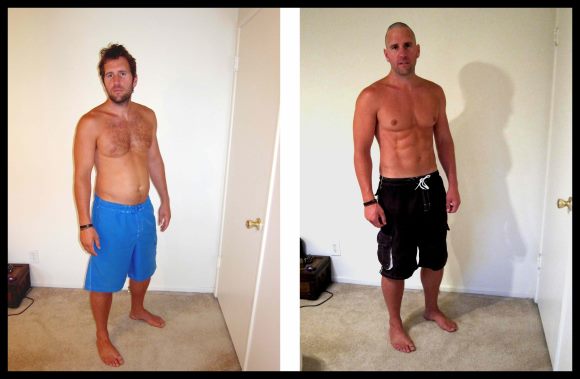
Say, do you look at “Before and After” photos and tell yourself, “Wow, how amazing?”

Why don’t we look at one now:

2013-07-24-ADixonTransform1.jpg

Oh, amazing! What if I told you that this guy “transformed” in about an hour. Yeah, that’s right; and it isn’t even Photoshopped.

His name is Andrew Dixon and he is a personal trainer. He says he is upset with the fitness industry’s fake transformation and decided to do something about it:

I decided to take my own transformation photos to see what was possible with just a few easy tweaks. About six months ago I was around 185 pounds and about 16 percent body fat. I was feeling particularly bloated on the day, so I asked my girlfriend to take a before shot. I then shaved my head, face and chest and prepared for the after shot, which was about an hour after I took the before shot. I did a few push ups and chin ups, tweaked my bedroom lighting, sucked in, tightened my abs and BOOM! We got our after shot.

That’s it? Well shit, no wonder the fitness industry has “amazing” before and after photos — it’s an illusion. Personally, I never thought that these things might be faked. I mean, who would do that if their product truly worked? But now that I know, it kinda seems obvious. Why wouldn’t these companies do this?

Pretty much every other image that we see of celebrities or people have been screened and/or altered in some way: magazines, TV shows, movies, ads. There is quite a lot of money involved in the fitness business; Beachbody’s product P90X has made nearly $200 million alone. So the next time you see a “before and after,” ask yourself what did that photographer do to make that person look better. 

Bonus: All over those two Huffington Post articles — to the sides, on the bottoms and also the suggested articles — there are “transformation” photos and articles like “Kim On Her Way to Regaining Figure” and “EXCLUSIVE: Spencer Matthews and his kangaroo diet!” (Kangaroos? Well I guess they could be tasty…)

Kitsune Yokai


Filed under: DT, EX, FN, Themeless Thursday, WL

Eating the Food: Two Weeks

$
0
0

Weight LossFat HealthExerciseEating DisordersMy Boring-Ass LifeDiet Talk

Trigger warning: Discussion of a personal diet (as in eating) plan and previous commitment to caloric restriction.

I’m two weeks into my 100-day Eating the Food Adventure.

To recap, two weeks ago I decided to start eating at least 2,500 calories a day. That’s a minimum, not a maximum. After years of studying Health at Every Size® and intuitive eating, as well as struggling with binge eating, I’m finally giving up dieting. For real. I’ve wanted to give it up for three years, but it just. hangs. on. You can read more about what I’m doing here. You can also follow along daily for 100 days on my Tumblr.

Today I want to answer a couple of questions that came up in the comments here and on reddit to my original article and give a two-week update.

Someone pointed out in the comments here (and on reddit) that it’s possible I’ve been underestimating my calories the last three or so years (and I suppose my entire life) when I’ve thought I was eating about 1,800 calories a day. Of course, they then went on to insist that either I was lying or a freak of nature, but whatever. You know what? It’s true that I might underestimate my intake. I haven’t tracked what I was eating with any consistency. I do have a long history of calorie counting (like 30 years) and I think that I can do it pretty well — but it is possible that I’ve underestimated my daily calories. There have also been days when I binged. On those days, I definitely ate far more than 1,800 calories. On occasion, I track what I eat and it always comes in at 1,800 or so. But I’m willing to concede that I both sometimes ate more on purpose and unwittingly.

What I can tell you for sure is that I’m eating significantly more now than I have in years. Maybe ever. And it goes to reason that if I was underestimating 1,800 calories, I’m also underestimating 2,500, so I think it all comes out in the wash.

There were also comments on my last posts about just eating whatever I want, whenever I want it, and being guided by intuition. My answer to that is simple: I’ve tried to be guided by my intuition for three solid years. I needed more help giving up restriction. Desire to stop dieting wasn’t enough to overcome a lifetime of conditioning. For me, making sure I eat a minimum number of calories that is a couple hundred more than what my body needs just for basic functioning (my BMR, or base metabolic rate, is about 2,300 calories).

Can I tell you something? Tracking 2,500 calories, and knowing (and believing) that it’s a minimum not a maximum, is like Christmas every day. Someone on a Facebook page I belong to compared it to paying all your bills and having plenty left over for fun stuff. YES. It’s just like that. Sometimes I log into my tracker (I use myfitnesspal.com) just to see all those yummy, beautiful calories waiting for me to eat the next day.

Do you know about spoon theory?

The main benefit I’ve received from eating enough for two weeks is more spoons.

Two weeks ago, I was so used to running out of energy at 3 or 4 in the afternoon that I never planned anything for later than that. My husband knew better than to ask me to do something at night with him. I rarely went out after dark. I also knew I had enough spoons to either work out OR go shopping in one day, but not both. Ever. And maybe not even both on two consecutive days.

Two weeks in, my energy is lasting until 8 or 9 p.m. I still have a crash — that moment when I’ve definitively used up all my spoons — but it’s happening significantly later in the day. I shopped and lifted weights yesterday, and still didn’t crash until 8 p.m. That might not seem like much to you, especially if you’ve always had adequate energy. To me, it’s huge.

To me, it feels like healing.

To me, it means that eating more is a big, fat win. It’s enough. Even if Eating the Food means gaining All the Weight (that hasn’t happened so far, by the way). This isn’t about my weight. It’s most definitely not about weight loss. My clothes still fit. I’m pretty sure my weight hasn’t changed substantially one way or the other.

Know what’s gone, though? Edema. For the first time in years, my feet and hands aren’t swollen.

Know what else? Insomnia. I’ve gone from using a sleep aide several times a week to falling asleep easily and sleeping through the night, then waking up rested. For the last several nights, I haven’t even woken up when my husband, who works an overnight shift, came to bed at 3 a.m.

And one more thing: headaches. I haven’t needed to take Tylenol in a week.

I still have some residual restriction-brain thought patterns. Every once in a while I have a familiar twinge of fear. “What if I fail again? What if I can’t do this?” Then I remind myself that all I’m doing is eating enough. Far more than I’ve ever consciously eaten before.

I want to make something clear. I’m tracking what I’m eating right now because I want to make sure I’m eating enough. I have a history of restriction and I need something, right now, to help keep me from slipping into old patterns. I have not been able to turn the idea of intuitive eating into something that I can just do. My goal is to be able to eat to my hunger cues and eat enough without needing the extra support.

For the first time in (most of) my life, I’m not on a diet or trying not to be on one. I’m just eating. And it feels amazing.


Filed under: DT, ED, EX, FH, MBL, Themeless Thursday, WL

Stuck in the Middle. Vegans hate fat people, Fat Acceptance people hate vegans. Where do I go?

$
0
0

Weight LossFat PoliticsFat HealthEating DisordersMy Boring-Ass LifeDickweedDiet Talk

Trigger warning: Discussion of veganism as a weight-loss diet and disordered eating.

I know, y’all might be tired of me talking about veganism all of the time, but it definitely has a special brand of fat hate. There was the Plan V that PETA (People for the Ethical Treatment of Animals… and objectification of women) pulled, along with PETA’s classic fat hate. But let’s be honest. it’s not just PETA pulling this shit.

What prompted this little rant? I went over to /r/vegan on reddit today and literally the first video I clicked on had fat hate in less than 30 seconds (and please, if you’re on reddit, please feel free to add a body positive comment to that video). The video opens with a man standing in front of McDonald’s saying that he’s planning on showing kids slaughterhouse videos. That’s the whole premise of the video. But he’s standing in front of a handicapped parking sign and at one point he says that McDonald’s has special parking when you become too fat or too immobilized to move.

Wow, just wow.

I’ve seen the studies people have pushed at me claiming that veg’s are thinner than meat eaters and I can tell you, it’s pretty much bullshit. There’s about a five pound difference and no study takes into account starting weight before going veg; meaning the people who go veg could, in general, be slightly thinner to begin with. This makes sense as veganism and vegetarianism has been picked up as another fad diet and health craze. One of those studies even refused to use vegans over a certain weight.

Vegans like to completely ignore the existence of fat vegans or, if they acknowledge us, we’re eating the wrong foods, stuffing our faces with Oreos and vegan cupcakes and fries all of the time. We’re bad for business, bad for the image of veganism. VegNews magazine on Facebook the other day posted a status about vegans needing to exude a healthy look to make veganism look as positive and tempting as possible. This ignores the fact that thin vegans eat junk food too and that, well, no one like a pretentious pompous health nut trying to act like they’re better than you because you had a candy bar while they munched on kale leaves.

But it’s not just all on vegans. I see quite a lot of veg hate from fat activists comparing veganism to disordered eating, eating disorders, starvation diets, etc. Veganism is mentioned casuallyVegan as something that skinny body policing yuppies do, again, completely ignoring the fact that there are fat vegans and even body positive fat vegans. Remember, veganism is a moral stance, not a diet.

If you eat a plant-based diet but still live a non-vegan life (e.g., wearing fur, leather, wool, using products tested on animals) then you’re not a vegan, you’re someone who follows a plant-based diet, a strict vegetarian. The point of me bringing up the fact that it’s not a diet is that because it’s not a diet it doesn’t clash with body positivity, Health At Every Size® (HAES), intuitive eating, or Fat Acceptance.

I’ve had an eating disorder, thanks very much! And veganism is most definitely not an eating disorder. Though with any “fad diet” (thank you asshats for turning it into that), it can be used for ill purposes, but most people just want to love animals and be left alone.

I’m tired of my ethical choices being used as a nail in the coffin for the body acceptance police and health zealots. Please just stop bashing vegans. Criticize the fatphobic ones! Criticize PETA! Do it! But please don’t generalize and pretend like we’re all bad people who hate fat people. Some of us are fat people and some of us want so badly to just be able to be fat and vegan without comment.

I’m stuck in the middle. I can’t talk to Fat Acceptance people about veganism and I can’t talk to vegans or be a part of their community because I’m fat. My husband has the same problem. We’re a part of all of these communities, but separate from them as well. It makes us feel stuck and lost and hopeless. Is there anywhere that we fit in? Anywhere it’s okay to be ourselves? If everyone could just stop being a dick to each other, that would be fantastic!


Filed under: DT, DW, ED, FH, FP, MBL, Themeless Thursday, WL

Swapping Body Talk

$
0
0

Last month I had the good fortune of receiving some body positive wares from our very own Dr. Deah, an exceptionally talented Health at Every Size® (HAES) educator, a creative artist, and a superb author (in an upcoming post, I will review Dr. Deah’s Calmanac, which can be found at her online shop). Today I wanted to discuss Deah’s line of body positive bumper stickers and magnets, which bear the slogan, “My ONLY weight problem is YOUR problem with my weight…” Deah sent me a few, along with the book to review.

Image

I began to develop into the body positive being I am today during my senior year in college. This was when I first began reading HAES blogs and books and engaging in academic research to more deeply explore topics related to size discrimination. It was also during this time that I discovered the wondrous website known as Cafe Press, a place where you can find products that are tailor made for almost every human interest known to man.

Do you like kitties? They have kitty calendars. Crude jokes? They have a t-shirt for you. Are you a fan of an obscure 70’s show? Order one of their custom-made mugs. They also had body positive products, with slogans such as “I’d rather lose hate than weight” and “Goddess… society does not dictate my beauty.” I ordered t-shirts and sweatshirts and wore them with incredible pride. I had people stop me to take pictures. I felt empowered. I felt invincible.

It is incredibly important for us to take control of the messages being spread about our bodies, especially if the common message is one that is associated with societal scorn or cloaked in shame. Dr. Deah presents us with products that allow us to slap the world in its figurative face and proclaim loudly that we are in need of a revolution. We are in need of a change in script. We — no matter what size or gender — are tired of body policing, and are wising up to the fact that WE don’t have a problem, the majority voices in society do. And that’s an amazingly powerful thing to recognize, and proclaim, as someone who has dealt with the scorn from a world that others your person and the insult from a community that invalidates your dignity.

It is vital that we invest in, create, and disseminate products that empower those who are targeted for being different than the oft-reimagined ideal. As definitions of beauty and power evolve, so must our willingness to change the messages we see being mass marketed if they reinforce an imbalance of power that emphasizes inequality, encourages injustice, and manifests as a hateful diatribe against ourselves and others. Dr. Deah’s products manage to do just that.

Kerasi sig


Filed under: Themeless Thursday

The Autoimmune Diet

$
0
0

Weight LossFat HealthEating DisordersMy Boring-Ass LifeDiet Talk

Serious trigger warning: Eating disorder discussion with calorie counting and diet talk.

raw-food-diet-center-1I have a new doctor. I sort of got him by accident. My general practitioner recommended him but at first I ended up seeing his nurse practitioner for my thyroid needs. Still, the head office peeps recommend I see him to “establish care.” When I told him I wasn’t there for any particular reason other than that he seemed a bit confused, but whatevs. We went over my health issues one by one. A bad ankle from an injury, bad knees from a genetic lack of cartilage, chronic bicep tendinitis from a fall several years ago, hypothyroidism (Hashimoto’s thyroiditis), bipolar disorder, migraines, and chronic nausea.

Yeah, it was kind of a long list (not as long as some, I’m sure). What was next was a discussion about autoimmune diseases and inflammation in the body. I’ve already seen my migraines lessen and my fatigue lift somewhat by eliminating gluten. But what was he talking about? Well, I don’t know how I’m going to manage to be honest and it’s triggering a lot of my old eating disordered thoughts.

You see, what I’ll basically be doing is a raw food vegan diet. I can’t eat anything in the nightshade family (including tomatoes… What? No!),  No corn, no potatoes, no peppers, no eggplant. No soy, no gluten or grains and, of course, no animal products. That doesn’t leave me with a lot, does it? Technically, I’m supposed to be eliminating nuts and seeds as well, but my doctor let me hang onto those. I see a lot of salads in my future. (I kid — I’ve actually found a lot of awesome raw food recipes). 

The annoying part, though, is that my doctor says he expects weight to just “drop off” of me. I looked him dead in the eye and said, “That ain’t happening.” When he asked why, I explained that I had an eating disorder for ten years and if that didn’t make me thin, certainly some stupid diet wasn’t going to. Still, he can’t seem to accept that I’m just naturally fat. No, it’s the fault of my meds not being high enough and my diet not being anti-inflammatory enough. It’s my leaky gut that’s causing me to be fat! So what if all of the women in my family are fat? They obviously must have leaky guts too, even if they don’t have an autoimmune disease like I have. The big thing I’m skeptical of was him linking my diet to my mood disorder. Well, my mom said he was a witch doctor, but I’m willing to try anything to avoid surgery and pain meds.

So what I’ll be struggling with is getting enough calories (last time I tracked calories, I ate between 1,400-1,800, so I need at least that many), getting enough protein, and finding meals that are filling and satisfying, as well as not triggering the “good fatty” inside me who wants to be proud for all the restricting I’ll be doing. At my ED worst, I was eating a veggie burger with ketchup (no bread) for lunch (100 calories) and tofu noodles (40 calories) with pasta sauce (150 calories) for dinner.

Oh god, it skeeves me out that I can still remember exactly how many calories I was consuming. You’re reading right though… I was eating about 300 calories a day at the time right before I found Fat Acceptance. It sort of makes me want to cry now. On one hand, I can’t believe I let myself get that low and on the other I’m so worried that I’ll do it again. It’s easy to under-eat when you’re literally eating nothing but fruits and veggies.

But I’m determined. I’ll stay body positive, I’ll keep loving myself AND I’ll keep to this diet to (hopefully) improve my health.


Filed under: DT, ED, FH, MBL, Themeless Thursday, WL

eShakti — great concept, struggling execution

$
0
0

Fat Fashion

We all know finding plus-sized clothing is a pain. The topic has been beaten to death, and then there’s the occasional A&F zombie attack. I’m not a fan of forcing people to take my money or demand they cater to me when they’ve made it clear they don’t want my business. I’d rather support their competition and take my money where it’s wanted.

One place that wants my business is eShakti, an e-tailer that sells clothing in sizes 0-36. Their premise is embracing technology to create customized garments at a price point similar to eShaktiboutique ready-to-wear. For an extra $7.50, you can have a garment tailored to your measurements with your choice of neckline, hem length, sleeve, etc. To get you hooked, customization is free for your first order.

The Good

  • Turnaround is really fast. This is relative because every garment, customized or not, is made when it’s ordered and then gets shipped from India. I bought a dress before going out of town, expecting that it wouldn’t arrive until I was back home. The shipment notification came a lot sooner than I expected, as did the delivery date.
  • They really want your business. If you don’t want to keep your garment, you can choose a refund for the amount you paid or a gift card for an additional 20%. Customization is non-refundable, but the gift card option covers the cost.
  • Some customizations, such as removing pockets, are free. If you think a dress is cute except for the hummingbirds embroidered on the skirt, they can be nixed at no charge.
  • Ready-made patterns tend to be for B/C cups. I’ve been at least a D since I was a teenager and have a big problem with button downs not buttoning down, empire waists cutting right across my bustline instead of underneath, and swimsuit tops not being much more than pasties. Having a pattern designed for my chest, bust, and underbust measurements makes for a better fit. Conversely, you can get rid of the gaping space in the chest area if you’re smaller than a B/C.
  • Hemlines are designed with your height in mind. A 5’10″ person’s knee-length skirt is going to be longer than a 5’3″ person’s knee-length skirt. I like my stuff to the knee or just above and they’ve gotten that right each time. There are also options for mini, midi, and maxi hems.
  • It seems like cap sleeves are the new short sleeve. I despise cap sleeves because they make me feel like my top’s too small. I really like being able to add more sleeve to my garment.
  • There are a variety of fabrics. A lot of plus size vendors tend to stick to various flavors of polyester. I’ve bought garments in silk, cotton, and a wool blend from eShakti.
  • New designs seem to come in frequently.

The Bad

  • Every shipment I’ve received came via FedEx and my vacation hold resulted in an epic snafu. Not directly eShakti’s fault, but it still makes me angry. They also require a signature to release the package, so watch your tracker closely or plan on getting one of those missed delivery notices. At least you can sign that and they’ll leave the box when they come back.
  • Even with custom sizing, the sizing seems inconsistent. I bought three dresses using the same set of measurements. One fit perfectly, one was ridiculously loose in the midsection, and one was too tight in the bust. The next trio brought two good fits and a miss. My last dress was a good fit. You could say they’re improving, but a 57% success rate isn’t exactly impressive.
  • Returns seem like they take forever to process
  • I’m really bad at visualizing what a garment is going to look like with alterations. They have icons of each option in the customization section, but I would kill for a WYSIWYG interface to show me what that top looks like with flutter sleeves versus elbow sleeves, even if they are just pasted on (yay!)

The Mixed

  • While there are design teams in California, New York, and India, all manufacturing takes place in India. eShakti has a brief statement about their labor practices here.
  • They love prints. I’m more of a solid color person, but there are options if you’re not.
  • Signing up for their mailing list gets you discounts and informs you of sales, but they email so frequently that Outlook now defaults them to the junk mail folder.
  • Fabrics and silhouettes are reused often. eShakti isn’t the only retailer guilty of this and there are pluses and minuses. On one hand, you might love a vintage sheath dress but hate the fabric offerings. Wait a few months and you might get one you like. If you love that anchor print, you can get it in a skirt, a top, or a dress. On the other hand, they might make the same dress in a fabric you love a few months later, but just can’t justify getting a duplicate dress.

I really want to like this company because I think their concept is cool. Unfortunately, their execution still needs work and I hope they get there. In the time I’ve been using them, I’ve seen their turnaround time go down and their clothing selection go up. I do like that they’re now soliciting feedback on new items; I’d like it even more if I got some sort of reward for doing so. I’m not a fan of their pricing, but I feel that way about most plus size retailers. Take advantage of their spam list to get notified for their buy two, get one sales offer and other discounts, or just stalk the site because it seems like they’re always running at least one promo.

Gingeroid Sig


Filed under: FF, Themeless Thursday

Happy Horny Skinny —

$
0
0

Weight LossFat HealthFat ScienceExerciseEating DisordersFat NewsWeight Loss SurgeryDickweedDiet TalkFat Sex

Trigger warning: Graphic discussion of eating disorders and fat shaming.

Back in 1999, Dr. Drew Pinsky, the popular addiction specialist turned TV and radio host, did something unconscionable that only caught up with him in 2012:Wellbutrin

A Boston judge on Thursday approved a record $3 billion guilty plea by British drugmaker GlaxoSmithKline, which paid the “Celebrity Rehab” doctor — known as Dr. Drew — $275,000 to tout Wellbutrin, approved by the FDA to treat depression, as a drug to treat other conditions including obesity, addictions and sexual dysfunction.

Dr. Drew infamously told “Loveline” listeners that Wellbutrin “could explain a woman suddenly having 60 orgasms in one night.” Dr. Drew was part of “Operation Hustle” (I am not making this up), Glaxo’s campaign to illegally promote the off-label benefits of its antidepressant. Sales reps wanted to promote the wonderdrug as the “the happy, horny, skinny pill.”

Dr. Drew’s “non-branded campaign” (as he called it in his public response to the charges) is the kind of conflict of interest that makes many of our readers wary of anti-obesity research, like bariatric surgeons who publish glowing research on weight loss surgery. But in a country waging a War on Fat, society tends to dismiss the means of getting thin, so long as the ends are impressive (see: Biggest Loser).

This kind of all-or-nothing approach to weight loss and (supposedly) health is nothing new, but it seems as though the impact that such a weight-focused approach can have on individuals is now affecting Dr. Drew in a way he might not have anticipated.

As a way of drawing attention to National Eating Disorder Awareness Week (NEDAW), Dr. Drew’s daughter, Paulina, publicly disclosed her seven-year battle with anorexia and bulimia. Last November, she first published a harrowing account in the Columbia Spectator about confronting her mother over her ED on a ride home from a nice restaurant. Her mom kept talking about some friends who owned a gym and their tricks for staying thin. The subject became too much for her:

My ability to listen to my mother talk about her gym owners had disappeared when I had hit rock bottom four months prior and had put myself into therapy. Purging eight times in one day to cope with the emotional stress of being home during spring break had finally scared me enough to take action. And here I was again, stuck in a car with her.

Without even thinking, the words erupted from my mouth.

“Well I’d rather have an over-eating disorder than an under-eating disorder.”

She said, “You don’t mean that,” to which I replied, “Yes I do. I’ve already had an under-eating one.”

Without missing a beat, she responded, “No, you haven’t.”

I paused, but before I knew it, the words were out of my mouth. “Yes, I have. I’ve been throwing up since the seventh grade.”

All of the air was sucked out of the space we both shared. This was not the way I wanted to tell her; this was not what I had planned. I had imagined a triumphant moment that involved eating a whole cake with my hands without breaking eye contact and saying, “YES, I HAVE BEEN A BULIMIC AND ANOREXIC FOR SEVEN YEARS. BUT NOW I AM BETTER. I AM EATING THIS CAKE BECAUSE I WANT IT AND I’M HUNGRY. AND GODDAMN IT TASTES GOOD.” But the words flew out of my mouth before I had a chance to take them back. The following moment was the longest and most painful silence of my life; I felt like my stomach was going to fall out and that I was going to projectile-vomit onto the windshield. After a silence that lasted far too long, she responded.

“Well, get your teeth checked.”

It’s a disturbing response, and one that the media has immediately picked up on as proof that the ED was her mother’s “fault.” And indeed, parents can definitely trigger EDs in people (my wife being one example I know intimately), but Paulina goes on to explain how her whole world centered around getting and staying thin:

My 13-year-long figure skating career fostered my eating disorder, which was normalized by the people around me. Both inside and outside the world of figure skating I was repeatedly praised for my “perfection.” Everyone constantly inquired about my thinness, asking how I did it and how they could emulate it. My hunger didn’t matter, I was told, because it was merely a means to an end. A friend’s mother told me that if I went to bed hungry, I would lose weight. And it was true. I began to realize that people liked me better thin. I had boyfriends who never failed to comment on how “amazing” and “beautiful” I looked; my friends and their mothers asked me what I ate and how I worked out. Thinness became my entire identity. Everyone needed me to be thin and, even worse, I needed myself to be thin. [emphasis mine]

Paulina makes the case that it takes a village to normalize an eating disorder, but admits that within her nuclear family, “‘diet and exercise’ is our religion.”

Paulina with her father and mother.

As a parent, I’m painfully aware that I will eventually do something or say something that may make a deep and lasting impression on how my children perceive themselves and their role in society. Parents screwing up their kids is inevitable (although there are varying degrees of effect), which is why, despite my initial disgust with Paulina’s mom, Susan, I read more about how she reacted in the long-term to her daughter’s ED. And from what I’ve read, Susan has been very supportive in the two years since her “get your teeth checked” comment.

And then I found this post in Susan’s blog regarding Paulina’s ED and that comment specifically:

I was terrified and speechless. I had no idea how to respond, since I have no formal training in this subject.  In a defeated voice I muttered my response, not to hurt her, to advise her as a mother would. Maybe I was angry because she hid this from me. As a mother, I’m frustrated and confused, even talking about it now. I feel like I failed as a mother and I sink into a deflated self. My baby girl was suffering from an eating disorder. How could I have not known? Her periods were normal, she was always at a good weight, and I never saw her vomit. No one knew.

Was it the best response? No. But people are complicated and their reactions, particularly to their children, can be unpredictable. But most importantly, Susan seems to have learned how to support Paulina. Even better, Paulina was strong enough to move forward and overcome her ED and she is now an fierce advocate for Body Acceptance. She’s leading events at Columbia University this week for NEDAW, including this awesome photo session promoting body positivity.

Pinskey

This is an excellent “lemons into lemonade” moment; the kind of moment you hope will come from such tragic circumstances. But I think her father still needs a wake-up call on how his attitude toward fat people may influence not only her daughter’s perception, but the public’s perception of weight and health.

Paulina shares an anecdote in this Bodies Endangered blog post that highlights his pragmatic problem:

When I was last home from school in June, I brought up Kim Kardashian during a family dinner. I hadn’t even completed my thought about how disgusting I found the media’s emphasis on her weight gain during her pregnancy, before my mother interrupted me: “Yeah. She got really fat.” I paused and looked at my father, hoping that he would start a riot on my behalf; he just mumbled his medical opinion under his breath, saying, “You know, it’s very unhealthy for the baby to gain that much weight. Could be Eclampsia, which is very serious.”

It’s the kind of comment you would expect from 9 out of 10 doctors, who are just as susceptible to the panic surrounding obesity as anyone else. But later, Paulina says something quite revealing: “From a young age I was told to crave hunger, to strive for it. If I went to bed satisfied, I felt that I had failed. This left me physically and emotionally starved.” Recall the bolded comments on hunger above. The emphasis on hunger played a significant role in Paulina’s ED, and we get a glimpse of where it came from in some of Dr. Drew’s podcasts.

LOVELINE (1996) Shown: Adam Carolla and Dr. Drew Pinsky

Dudebro and the Doc (1996)

If you weren’t aware, Dr. Drew frequently partners with an unrepentant douchebag named Adam Carolla, who is best known for his racist, sexist, homophobic and transphobic rants. Like his cowardly progenitor, Tom Leykis, Carolla’s public relevance is tied directly to the stagnant supply of perpetually-threatened dudebros who need constant reassurance that they are the kings of their domain (“their domain” being mom’s basement).

The dynamic is that Dr. Drew is the yin to Carolla’s yang… Carolla is the abrasive “straight-shooter,” while Dr. Drew legitimizes whatever the fuck Carolla spews out by polishing it up with his benign, clinical manner, thus softening the dudebro message for a broader audience.

I haven’t seen the Dynamic Duo in action since the ’90s, so I thought I’d see what they have to say about fat people and I was shocked — SHOCKED! — to discover that Carolla is an equally colossal douche on that subject as well. I stumbled upon this podcast from exactly one year ago, during which Dr. Drew talks about his diet.

“How’s your diet work?” Carolla asks.

“I don’t eat,” Dr. Drew says. “Here’s how I know I’m okay: I’m hungry. And then I try to eat so much that I don’t get full. I eat good, balanced, low fat, high protein, but I try not to get full so that I’m like hungry an hour later. That tells me that my body’s using its resources. So I’m hungry all the f’ing time and it aggravates me.”

Sound familiar?

This is the kind of thing Paulina was taught throughout her life: hunger is the goal, hunger is something you should crave, something you should strive for. It’s a kinder, gentler version of “Nothing tastes as good as skinny feels.” And it’s not just the advice he gives his daughter, it’s the advice he still lives by to this day. My question is, if cultivating hunger is such an effective and sustainable weight loss strategy, why does Dr. Drew have to keep starting new diets?

Right on schedule, Carolla gives the standard dumbass dudebro diet template that he thinks people have somehow forgotten. “I’ve found that most people say this and the number 1 ‘Hey, you used to be fat, why are you not fat any more?’ — stop drinking soda and started walking is usually the number 1 answer.” I’ve got news for Carolla: I don’t drink soda regularly and I walk all the damn time. Why am I not skinny, yet? “It’s insane that there probably have been more books written about dieting than there have been about World War 2, World War 1 and Vietnam.”

“Oh sure, all wars combined,” Dr. Drew responds.

Ignoring why there are so many books about dieting, Dr. Drew goes on to explain his theory on the “obesity epidemic” by claiming that “people are so unregulated emotionally that they use food to regulate their emotions and then they can’t contain — they have no frontal lobe function — they can’t contain their desires.” Again, recall Paulina’s comment about how the emphasis on staying hungry left her “physically and emotionally starved.”

[Sidenote: Regarding the popular claim that obese people are brain-damaged or, as Dr. Drew says, "they have no frontal lobe function." The prefrontal cortex (PFC) controls executive function, which includes working memory, reasoning, task flexibility, and problem solving. Basically, the line of reasoning goes that either getting fat damages your PFC or a damaged PFC makes you fat. The most frequently-cited study on the topic compared the PFCs of ten lean, nine obese, and eight formerly-obese women and found that obese women had the least active PFCs.

Pre Frontal Cortex

Of course, this doesn't explain why the lean women with a BMI of 26 had greater PFC function than formerly-obese women with a BMI of 28. If PFC were affected by weight alone, you would expect that function to be more comparable. But if you dig a little deeper, you learn that leptin-deficient people have lower functioning PFC as well, and when they receive leptin injections, their PFC improves. Leptin reduces their constant hunger. Fat people tend to be leptin resistant, so their body doesn't process the leptin as well. Could this affect PFC function? And does weight cycling affect PFC function, such that extreme cyclers have lower PFC function than non-cycler? And, as always, how does fitness affect PFC function? All unanswered questions, but, yeah, let's just run with fat people are brain damaged.]

Carolla goes on to talk about his recent experience at Disneyland, complaining about all the fat people in scooters and how scooters should be for people who are too physically frail to ride the Matterhorn, which is like “being gang-raped dry.” Dr. Drew laughs about this and joins in the rape jokes, which is problematic on a whole other level.

Anyway, Carolla wants the audience to know that Disneyland is full of horrible, horrible fat people and he goes on a rant that tells you exactly what you need to know about where his concerns for their health and well-being:

When you see the 63-year-old chick walking around and [she's] got the extra 30 pounds on her or 50 pounds pounds her, okay. But when you see the 19-year-olds — lots of ‘em, lots of ‘em — and I always notice especially the women… guys can go ahead and play nose guard for the football team or still occasionally get laid or even if they have to, just buy a prostitute. But the fat chicks, socially — and I also started doing a map, so a couple things: a) many of the employees over at Disney are not husky and not fat, but morbidly obese. You’re talking about women that are — and men, but I always say I notice the women because it impacts their life socially more greatly. [emphasis mine]

Dr. Drew chimes in with, “You feel bad for them.”

Gee… why is it that fat women are more socially impacted than fat men again? Let me scratch my big, dumb, hairy chin a minute and think…

So, Carolla goes on to lament the fact that he only sees the fat female Disneyland workers paired up on to work the rides with other fat females. “What they should really do, honestly,” Carolla ponders, “they should put the thin ones with the fat ones so that the fat ones have something to look at —”

“Some motivation,” Dr. Drew says.

“Other than themselves,” Carolla responds.

“For health reasons.”

Yes, clearly Carolla’s concern for these “fat chicks” is their health. And his reasons for making fun of fat women is because he’s concerned for their health. Carolla goes on to talk about how when his writing partner is on a diet and they go out to eat together, he tends to eat better, which is something Dr. Drew calls “social motivation.”

Carolla goes on to lament the sad PUA fact (and PUA is nothing if not sad) that “when you’re out on the hunt,” he has to deal with fat chicks. I’m including this rant because this is the kind of shit that Dr. Drew contributes to on what is half his show:

There was always the chick who was a little chunky, but not fat, just a little chunky, do you know what I mean? And had a little extra bosom on her, which was a plus, but a little extra ass on her, which was not a plus, unless you’re a black guy, and you were like — but there was always that chick. There was the chick — there were hot chicks, there were chicks that looked great in their bikinis and then there was that chick that was cute in the face, but she was just like 15, 20 pounds away from being hot, you know? And it was kind of understood. It was almost a shame. She had beautiful eyes, but kind of a big ass, you know? And that chick wasn’t 100 pounds overweight. That chick was 10, 15 pounds overweight. She’d be smokin’ at 125, 130, but she was more 140, and therefore blowjobs only and everyone felt sorry for her. That chick who was 10, 15 pounds overweight and could never really get past that mark, you know what I mean? Every once in a while she’d drop a couple pounds, but she’d quickly get up to that fighting weight. So cute, but always a little extra meat on her, just enough to get her off the desirable chart for most of the guys.

This is the kind of mentality that drives young women to a perpetual dieting or, worse, eating disorders because they are taught think of their bodies in this way by our culture. Most of that cultural influence comes in the form of ubiquitous subtlety: Adam Carolla’s dream woman in every magazine, movie, TV show and pop music act. This teaches women and dudebros alike that 140 pounds is something to be ashamed of, something that makes a woman completely undesirable. And now Carolla is scandalized by women who weigh over 200 pounds. Dudes who weigh that much? That’s fine. They can be noseguards and still get laid.

But remember: it’s all about health.

So Dr. Drew tries to reason with Carolla about changing social standards, saying, “Is it possible,  you know, women really set the tone for what’s attractive, you know what I mean? Is it possible things are changing and guys are sort of into that? Because there are those guys who are into it. And those are the ones that are into are into it.”

“I agree, but until Sports Illustrated or Victoria’s Secret has one of these chicks show up on the beach —” Carolla retorts.

“Okay, enough said,” Dr. Drew says. “Touché.”

“Because that’s who decides.”

Exactly.

And here we see the biggest problem with Dr. Drew: when faced with Carolla’s toxic misogyny and tireless douchebaggry, Dr. Drew rolls over completely. He wants to be the voice of reason, but he can’t help but join in on the joke because otherwise Carolla mocks him for being spineless. This willingness to yield to Carolla’s brute opinions takes a particularly ugly turn when the conversation turns to hunger in America and how cheap food has gotten. Carolla compares the price of gas at the start of Obama’s term to now (which is incredibly misleading, since gas prices spiked throughout the Bush era wars, but dropped just before the 2008 election) and how the price of tacos has barely moved.

“Well, kids go to bed hungry every night, Adam,” Dr. Drew says, sarcastically. “They’re starving. There’s hungry kids everywhere.”

Carolla laughs derisively and says, “They are not.”

Dr. Drew then explains how people can simply panhandle in a subway for 50 cents and get a whole meal from Del Taco, adding that people can “do it every day with no end in sight.” Carolla reminisces on the good ol’ days of poverty when you’d beg for money all day just so you could afford a loaf of bread and a can of beans.

“That’s the point: are we starving or are we obese?” Dr. Drew says. “Especially when I hear hunger commercials, I get confused. I don’t understand. How could a third of children go to bed hungry and be obese? Maybe that’s the problem.”

Carolla talks about how he goes to bed hungry all the time. I mean, what’s the big deal, guys?

“And by the way,” Dr. Drew adds, “when I’m not hungry, I’m gaining weight. I need to be hungry or else I’m in trouble. I’m hungry right now.” Again, we see the Pinsky’s Cult of Hunger on display.

Carolla returns to the subject of fat girls at Disneyland and says that he thinks there are more fat women than men, which is “that’s something that’s new and weird and sad, which it used to be a 23-year-old chick was like, ‘Hey man, I gotta look good because I gotta get myself a man to marry me in the next five years.’”

Again, we see the facade of health laid bare. This isn’t about whether fat people are healthy, but about whether fat women are motivated enough by Carolla’s pin-dick to lose weight. But Dr. Drew puts a “positive spin” on it by reminding us that women get fat because they are fucked up.

“But what we’re seeing is ‘I’ve gotta keep this big thing around me to protect me from people so I don’t get abused the way I was as a kid,’ which we know — you and I know — that’s the majority of this shit.” Okay, so far we’ve learned that fat people are brain damaged and the majority of fat women have been abused. Great analysis, Doc!

As if this weren’t bad enough, Carolla then endorses stigma as the best way to motivate fat people. “There’s nothing that keeps people in line like ‘I don’t want to fuck you fatty.’” Dr. Drew laughs and laughs at this hilarious observation, completely ignoring the fact that if weight stigma actually produced results, then obesity rates would not have risen between 1980 and 1999, when mocking fat people was par for the course.

Carolla continues, “I will not hang out with you, I don’t want to be your boyfriend or your girlfriend, I don’t want to be engaged to you, I don’t want to start a family with you because you’re unattractive to me and you’re unhealthy. Now that is the ultimate ‘Get in line, straighten your shit out.’” As you read about Adam Carolla’s concern for health, bear in mind that this is the man Dr. Drew himself said is “almost an alcoholic.”

As with most of this shit, Carolla is pulling success of motivational stigma out of his ass, since researchers have studied stigma extensively and know how ineffective it is in motivating people, particularly weight stigma. Dr. Drew is an addiction specialist, so does he believe that stigmatizing drug addicts will help them get clean? If not, then why does he let Carolla spew this unfounded bullshit day in and day out on his show?

It’s because Dr. Drew has no fucking clue what the fuck he’s talking about. Recently on CNN, Dr. Drew answered viewer questions and when asked about exercise bulimia, he responded, “I got a whiff of exercise bulimia. You sort of exercise too much, and if you miss it you freak out. You have to constantly exercise.  I don’t feel right if I don’t do it.  But, you know, a little whiff of mental health issue never hurt anybody.” Really, Dr. Drew? You think getting “a little whiff” of a mental health problem doesn’t hurt anybody? Perhaps that’s why you think Carolla has a little whiff of alcoholism? And have you asked your daughter what that “whiff” can do?

I found another Carolla/Drew podcast from November, shortly before Paulina published her article on her ED. Once again, both Carolla and Dr. Drew mock the idea that poor people can’t feed their kids, and again, Dr. Drew says “You can eat for a dollar a day in this country, easily.” He then follows this up by saying, “I’m anti-obese, I’m pro-hunger.”

Dr. Drew listens as Carolla proposes yanking everybody off food stamps and performing a kind of tough love experiment that forces families to take responsibility for themselves and he speculates on how many people would really starve. “Ten million? Five million? Two million?” All of this, Dr. Drew listens to and responds to positively and reinforces Carolla’s message, as though this Cro-Magnon, knuckle-dragging fuck-face has all the world’s problem’s solved, if we’d just snatch food stamps away from hungry kids because they don’t understand how you can be poor and fat.

Dr. Drew promotes a two-dimensional view of these enormously complicated issues: fat is bad, thin is good; the poor should eat fast food and not get fat; and hunger is always, always good. You can’t take shortcuts when it comes to health messaging. A doctor can’t promote drugs for off-label purposes for a quarter-million dollars and say it’s what he would have said anyway. A parent can’t teach their kids that hunger is a virtue and be surprised when one of them develops an eating disorder. A celebrity can’t suggest that perhaps poor kids would be better off going to bed hungry and not sound like a monster.

I am glad that Paulina has recovered from her eating disorder and that her relationship with her mother has improved. But her father is still promoting misinformation and a collaborating with a man whose definition of health is how fuckable she is, defined by whether she’s a 140 pound lard-ass or a 125-pound babe. Dr. Drew is part of the cultural problem that emphasizes looks as a proxy for health, which is critical trigger for eating disorders in young women.

Paulina may have escaped the harm of eating disorders, but nearly 30,000 women are hospitalized each year for ED-related health issues (PDF). Isn’t it about time that Dr. Drew takes an ethical stand for them as well? Isn’t about time Dr. Drew told Adam Carolla to shut the fuck up?


Filed under: DT, DW, ED, EX, FH, FN, FS, Themeless Thursday, WL, WLS

Baby Steps

$
0
0

Weight LossFat HealthEating DisordersMy Boring-Ass LifeDiet Talk

Trigger warning: Detailed discussion of disordered eating.

yogurtI have been reading the progress of Shaunta and her Eating the Food experiment and it has inspired me to my own experiment.

My experiment has been nothing so structured as hers, which is partly why I haven’t written about it yet. Also, I fail more than I succeed so far.

Because of my past (being starved as a child and early teens, then starving myself by dieting from early teens to my late thirties), I just don’t think about eating. I usually get one full meal in a day when I make brunner for my husband (brunner means whichever meal he can eat either before or after work, depending on which shift he’s working that month). On his days off, we will usually have two meals and then he’ll snack on other things throughout the day.

I know it isn’t healthy to get the vast majority of my calories in one meal. Yes, I do a little bit of snacking, but it’s not often. And usually I don’t go for the nutritionally-dense food when I snack because all of the sudden my blood sugar drops and I need something now, of course.

Since the beginning of the year, I’ve been trying to eat at least two meals a day. I know even that’s not enough, but it’s baby steps here. And as I said above, I’m “failing” more than I’m succeeding.

I have noticed that on the days when I do remember to have two meals, and sometimes even nutritious snacks, I have so much more energy to do things. Lately, when I forget an early day meal, I’m tired, I need a nap, and I’m headachy all day. When I remember to eat anything that is nutritionally dense in the morning — leftovers from the previous day’s brunner; a scrambled egg; a homemade wrap with avocado, tomato, and lettuce in it — my day goes much better.

So, you’d think it would be easy for me to remember.

I’ve developed strategies for eating more than once a day, even: have simple foods ready so I don’t have to prepare something just for myself; hard boil a few eggs once a week so I can just grab one or two when even making a wrap is too hard.

At the present, I have a batch of homemade yogurt in the refrigerator, and presliced strawberries waiting for me to combine them (with a few nuts). I have the makings for a veggie wrap. I have a few hard-boiled eggs.

Most of the time, I don’t remember any of them. Most of the time, when the minor hunger pains hit, I ignore it. And so, most of that food ends up being thrown away because it’s gone bad.

It’s hard for me to get rid of the internalized messages: you don’t deserve to take up any space, you are fat and fat people shouldn’t eat, starving yourself is the only way to be healthy when you are fat. I know none of these are right. I write about how size does not equal health or lack of it all the time. I’ve written about how eating appropriately is a form of self-care.

Yet, in the two months I’ve been trying to eat more, eat even just two meals a day, I haven’t been able to get there more than maybe a third of the time. It’s progress, yes.

Baby steps. I have to continue to remind myself that I didn’t get to disordered eating habits in one day. It took many years for me to get to this point. Even with everything I’ve learned from Health at Every Size®, the ingrained habits of neglecting myself, and actively trying to starve myself, are not going to go away overnight.

I look forward to the day that I am eating two meals a day consistently, along with various healthy snacks. But right now, I’m not to that point. Right now, I still have to constantly remind myself to eat more than once a day.


Filed under: DT, ED, FH, MBL, Themeless Thursday, WL

Eating the Food: Twelve Weeks

$
0
0

Diet TalkWeight LossFat HealthFat ScienceExerciseEating DisordersMy Boring-Ass LifeDickweed

Trigger warning: Discussion of calorie counting in order to eat enough food to meet daily caloric requirements, and subsequent, modest weight loss.

The twelve-week mark for my 100 day Eat the Food experiment came and went a couple of days go.

Just as a reminder, I decided twelve-ish weeks ago to eat above my base metabolic rate (BMR) for 100 days. BMR is calculated based on gender, age, weight, and height. It’s the number of calories your body needs to keep your organs functioning if you lay in bed all day. If you don’t eat those calories, your body will metabolize your fat and lean tissue to get them. Total daily energy expenditure (TDEE) is the number of calories your body needs to maintain your weight, taking your daily activities into consideration. My TDEE is 3,100 calories. I used this calculator to figure out my BMR and TDEE.

For 100 days, I’m eating AT LEAST 2,500 calories. That’s the minimum, not the maximum. And that’s net, which means that I eat back the calories I burn through exercise. I’m blogging about my experiment daily.

Today I’ll answer some questions that I’ve been asked and let you guys know how it’s going otherwise.

Greenline

So, my ten week post caused a bit of a rumpus.

I want to make a couple of points, to be sure that they are absolutely clear.

  1. Fat people’s bodies burn more calories than their thinner counterparts. That means that their TDEE is higher. At 5’9″ and 340-ish pounds, mine is 3,100 calories. That’s the number I need to eat to maintain my weight, assuming a sedentary day. On days that I swim, my TDEE goes up to about 3,800 calories. It’s important to know what your TDEE is because eating too far below it is uncomfortable. Notice, I didn’t say that you will die instantly, after your organs suddenly stop working if you eat way below your TDEE for a day. Your BMR is a good counterbalance to your TDEE. It gives you a window. If you aim to eat between these two numbers consistently, you may find that you have more energy, you sleep better, your whole body starts to thrive in a way that you didn’t even know was possible. That was my experience, anyway.
  2. Some people got upset because my experiment involves making sure I eat at least 2,500 net calories a day without talking about an upper limit. I can only assume that they believe that fat people are like a dog I once had who would eat until his belly popped if I gave him unrestricted access to food. Like “Fat lady is letting herself eat whatever she wants with no limit to her calories, she must be eating her body weight in cake everyday (and that’s a lot of cake because OMG she’s huge).” Turns out though, that by letting go of limiting what I can eat, I’ve finally been able to stop binging. When I know that I can eat as much as I need to, I actually have found that I just want to eat as much as I need to. I don’t have the urge to eat an entire bag of mini peanut butter cups or every bite of a restaurant meal. I’m still healing, but switching my focus to making sure I eat enough, from trying to make sure I don’t eat too much, has been a life changing experience for me. Not limiting your calories is not the same thing as going on an all-day-every-day-for-the-rest-of-your-life binge.
  3. When it comes to Health at Every Size® (HAES), people who consider themselves anti-HAES are woefully misinformed about what HAES is. HAES does not claim that everyone on earth is already healthy. HAES advocates for taking a proactive approach to health in a weight-neutral way. You don’t get kicked out of the club if eating intuitively and getting some exercise causes weight loss. You don’t have to turn in your HAES card if you hope that happens.

Okay, that’s off my chest. I feel better.

I’m closing in on the end of my 100 day experiment. I didn’t have any real idea that it would be this successful when I started. I hoped to have some more energy and improve my sleep, and maybe not hurt so much. I added ten minutes of exercise a day to my goal because that was honestly all I could manage in December.

This week I made it to 1,100 meters toward my goal of being able to swim 3,000 meters. I am consistently sleeping eight hours a night with no sleep aid. Since December, I’ve added to my days school first; then the edits for my book; increased my non-exercise activity thermogenesis (NEAT) by ten-fold at least; plus an ever-increasing amount of exercise, and my energy level has kept up beautifully. When I’m tired at the end of the day, it’s the good kind of tired — not the “system crash” kind of exhausted.

I think that eating consistently at a level that is below my TDEE, but above my BMR, has been a big winner for me. I have a steady, even level of energy throughout the day. I’m positive that a lot of feeling better has come from having the energy to exercise in a way that I really enjoy. It’s all a nice, little, self-propelling cycle that is so much better than the restrict/binge cycle I’ve lived with most of my life. There is no wagon to fall off because all I’m doing is eating enough and exercising moderately.

I started this experiment not wanting to focus on weight at all. During Le Rumpus, I found myself repeating over and over that what I’m doing works because I have lost about a pound a week during it. I sort of regret that now. Not because it isn’t true, but because I don’t think that going from 360 to 345 pounds  (or 350 to 335, depending on which scale I use — 15 pounds, either way) is the real proof that eating above my BMR and getting some exercise has been a successful endeavor. The benefits I’ve received so far outweigh the amount of weight that I’ve lost, it almost doesn’t even feel reasonable to credit weight loss for any of it.

I still wear the same size clothing. I’m still the fattest person in the pool when I go swimming. I still have a BMI in the high 40s. But I have no more pain. I have no more sleep problems. I have no more 3:30 pm total body system crash. I’ve gone from being able to barely swim 150 meters to swimming a nice, strong 1,100 meters. Those 15 pounds are the very least of the benefits that have come from the last 88 days.

I am not sorry that I’m losing a little weight. It just feels like another way my body is adjusting to getting a consistent amount of food and more exercise everyday. HAES is not about wanting to be fat. It’s about accepting your body the way it is. In my case, it means accepting my fat body and not waiting for thinness before I start showing it some respect. Eating well and exercise and body acceptance. I have been blown away by the results of truly practicing all three.

I’ll be starting another 100 days on March 25. If you’re interested in joining me, you’re more than welcome. If you’d like to receive a weekly newsletter, drop me a line at shauntagrimes at gmail or follow along on my personal blog. I’ll be posting journal prompts every day. If you have any questions, feel free to ask them.


Filed under: DT, DW, ED, EX, FH, MBL, Themeless Thursday, WL

Choosing scooting

$
0
0

Fat HealthMy Boring-Ass LifeDickweed

Last week I had the awesome opportunity to go on a cruise with my family, but for numerous reasons I didn’t want to bring my manual wheelchair (internalized ableism, ableism from my family, structural ableism). I picked up a rollator on Ebay so I could be more supported than my forearm crutches….which worked, kind of.

2014-03-14 12.50.05

So here’s my rollator, tucked in the “accessible” stall at Chichen Itza in Mexico. While it helped me be able to get around on my trip, it was also a huge source of frustration. People would literally shove me because I was walking too slowly. If I had a plate of food on the seat in the buffet, people wouldn’t look down, so they’d trip on my rollator (thankfully I never had a plate go flying). Elevator doors wouldn’t be open for long enough to allow me to get on… or the elevator would fill up from abled people and strollers, leaving me to sometimes have to call up to four different elevators to get up a floor on the ship.

What I realized is that sustained walking (aka ambulation in medical terms) is bad for my physical and mental health. By the end of the trip, all I wanted to do was deliberately ram people that got in my way. I was swearing like a sailor every time someone did something to me. I was in so much physical pain that one night I slept an hour, while I spent the other hours in the fetal position crying in agony.

Although I have a manual wheelchair, my campus where I work and study is horrific for accessibility. The hills are awful, the sidewalks are either sloped sideways, cracked or not wide enough for two-wheelers to pass each other. Add to that my hypermobility disorder, which means I get tendonitis, sprains and strains easily… so if the surface isn’t relatively flat, I end up hurting myself. I’ve realized that I need …

*insert dun dun duuuuuuun sounds*

… a scooter.

There is a huge amount of stigma with being the fatty on a scooter and, as much as I try to be a Fierce Fatty who doesn’t give a shit, I’m still a tenderhearted person who’s been bullied all my life for my weight. I’m still the person who is still struggling with a change in identity from “strong fatty” to “gimpy fatty”… and it’s a daily struggle, especially because I’m a physical activity scholar and I have to fight fatphobia, as well as justify my existence in the field, on a daily basis.

I’m trying to remind myself that the benefits outweigh the costs. I’m looking at this lightweight travel scooter that I can tuck discretely in Scootermy office without it screaming SCOOTER to everyone that passes by. I can get a cane or crutch holder on the back for when I want to stand. I will have the spoons to be able to do actual fun exercise instead of wasting my precious energy on ambulation. I will get to actually “walk” from my house to campus because it’s a little under a mile each way. I will be able to move my body through space at a pace that doesn’t make me want to injure other people!

The problem with a scooter is really the cost. Most insurance policies in the United States won’t cover a scooter that’s only used outside the home, so I’m left with trying to fundraise to try to be able to afford mobility equipment (which is probably better than when I used a student loan to buy my manual wheelchair, but more demoralizing). Walking is severely privileged in most societies, so deliberately choosing to walk less (especially as a fat person) is a difficult decision.

Honestly, I’m just hopeful for a time when I can get around without swearing like a sailor because of pain, my slow, gimpy gait, and disrespectful people!

UPDATE

I’ve created a Go Fund Me page for people donate money or you can buy Team Gnomercy t-shirts and sweatershirts.

Shirts

Casey Sig


Filed under: DW, FH, MBL, Themeless Thursday

Trapped in the System

$
0
0

There is a story I have been following for some time through conservative and Pro-Life news sources. When I initially considered writing about it here, I was shocked at the lack of coverage in mainstream news sources. Even today, I was debating between doing a roundup of miscellaneous links or signal-boosting the story. In light of the latest development, the boost won out. People who warn of government overbearance are often told they’re loony because it hasn’t happened, isn’t happening, and won’t happen. We’re very good at convincing ourselves that bad things happen to other people. Justina was not the first person, nor will she be the last. She is the most visible person, for now so it is her story that I am telling.

Pelletier

Justina, Linda and Lou Pelletier (photo via A Miracle for Justina)

Imagine your child is sick. Their symptoms indicate a systemic disease, but nobody can figure out what’s wrong. You subject them to increasingly invasive tests in the hope of finding answers. You’re about ready to give up when you find a specialist who makes the diagnosis of mitochondrial disease. According to MitoAction, about 1/2000 children will develop mitochondrial disease by age 10. Diagnosis is a challenge because the symptoms are shared by many diseases, and that’s not counting the doctors who write you off as crazy, lying, or fat.

Because your body is already running on fumes, any illness needs to be taken very seriously. In Justina’s case, it was the flu that brought her to Boston Children’s Hospital on February 10, 2013. Although her main doctor is at Tufts, her gastroenterologist had just transferred to Boston. If your expectation would be to take your child to the hospital, get admitted, and see the GI doc ASAP, you’d be wrong. What actually happened was a neurologist overruling her diagnosis of mitochondrial disease because he believed it didn’t exist. He diagnosed somatoform disorder, hijacked the admission, and she was placed in a psychiatric ward. The Pelletiers tried to get Justina out of Boston Children’s and to a facility that would treat her illness. Four days later, Justina became a ward of the state.

Her parents tried to play nicely with Boston Children’s Hospital and the Department of Children and Families, who currently have custody of Justina. Once the state got involved, the Pelletier’s lives went to hell. Parental visitation was supervised by local law enforcement. Phone calls home were monitored. Justina resorted to smuggling notes out in origami and her parents were forbidden from taking photos. At one time they were allowed daily visits, now they’re permitted weekly visits. The Pelletier’s only recourse is through the court, where they were placed under a gag order. Imagine having your child taken away because you were trying to do the right thing, and then being unable to tell anybody.

They complied with a gag order for nearly a year before Lou and Linda started to speak out in specifics about what had happened to them. In response, the court moved to hold them in contempt. Enough people were listening to persuade the court to drop the charges. Not only are the Pelletier’s running out of money and morale, but Justina is running out of time. Over the past year she went from an active teenager living at home to being wheelchair-bound, hospital-bound, and grossly mistreated in the state’s care. Her family fears she is experiencing sepsis while the DCF believe it’s all in her head. Because they don’t have custody, her parents aren’t informed of Justina’s treatment. Despite a court order issued earlier in the month for Justina to be evaluated by her Tufts team, she has yet to see any of the physicians who were treating her mitochondrial disease. On March 26, a judge ruled that her parents have no chance of taking custody for six months because they he deemed them unfit.

Why are they unfit? Justina’s dad called the hospital staff Nazis. He’s threatened legal action against another organization who would potentially take custody of his daughter. He’s threatened to call the FBI. You know, things an outraged parent might do. And of course, they vehemently disagree with the somatoform diagnosis. Returning Justina to her parents’ custody would mean resuming treatment for her mitochondrial disease rather than continuing psychiatric treatment for somatoform disorder. In short, they dared question the wisdom of the state. View the ruling for yourself.

Surely there’s something else, right? Hospitals don’t just kidnap children, states don’t just isolate children from their parents, and judges don’t just refuse to issue rulings for the hell of it. Does it complicate matters knowing Justina has a port in her abdomen for colon irrigation? If this was a case of medical child abuse, you’d expect Justina to be better away from her allegedly barbaric parents yet that’s not the case. The Pelletiers have three other children, including another daughter who also suffers from mitochondrial disease. None of them have accused their parents of being abusers. The DCF in their home state of Connecticut did a home visit and found nothing.

As I said, this is not an uncommon story. Browsing through MitoAction, I saw several families who’d lost their children in Houston. In Alaska, parents lost custody of their child over a diagnostic disagreement. How many times is this happening that we don’t know about because the parents are silenced? It’s hard enough being taken seriously by doctors as an adult. As a minor, you have no rights and no voice. If the rulings against the Pelletiers are allowed to stand, it sets a precedent to silence the parents as well.  Justina’s case is just the highest profile one, for now. Once the state is involved in an abuse allegation, parents have very little recourse. It’s a guilty-until-proven-innocent paradigm and innocence is very difficult to prove. Remember the debate over whether a fat child was indicative of abusive parents?

You can follow A Miracle for Justina on Facebook for updates from the family. Donations to their 501(c)3 can be made through PayPal here.

Gingeroid Sig


Filed under: Themeless Thursday

Do We Really Need a Dietary Bad Guy?

$
0
0

Fat HealthFat ScienceDiet TalkFat News

Have you heard?

Saturated fat is not bad for your heart.

According to the linked Huffpo piece above, it’s SUGAR that was the boogie man all along. Sugar is the cause of every obesity-related health problem there is. Sugar is the real bad guy.

From that article:

So let’s not kid ourselves anymore about what’s really making us fat. Sugar is the leading culprit today in causing inflammation. Here are some specific stats from an article printed in February 2014 in the Journal of the American Medical Association [JAMA], which are worth sharing:

  • Sugar is connected to an increased risk of heart attack and dementia, as well as other inflammatory diseases, such as insulin resistance and Type 2 diabetes, obesity, liver problems, arthritis, reduction in beneficial HDL cholesterol, increase in triglycerides, and cancer.
  • Those with the highest sugar intake had a 400 percent higher risk of heart attack than those with the lowest intake of sugar. Note the current recommendation by the American Heart Association: One’s daily intake of sugar should be only 5-7.5 percent of one’s total caloric intake.
  • It takes only one 20-ounce soda to increase your risk of heart attack by 30 percent.
  • If you consume 20 percent of your calories from sugar, your risk of heart attack doubles.

A single 20-ounce soda increases your risk of heart attack by 30 percent? Maybe the author meant to say 20 ounces of soda a day. I dug a little deeper and I found this article. Here’s the quote that really struck me from this source:

There is disagreement about how much added sugar is acceptable in a healthy diet, they note. Added sugar should be less than 25% of total calories according to the Institute of Medicine, but less than 10% of total calories according to the World Health Organization. The American Heart Association has even stricter recommendations: less than 100 calories a day (about 5% of total daily calories) for women and 150 calories a day (about 7.5% of total daily calories) for men.

How awesome is that? Recommendations for daily sugar intake range from 25% for everyone by the Institute of Medicine to 5% for women by the American Heart Association (AHA). That’s a pretty massive range, right? For a 2,000 calorie diet, 25% is 500 calories and 5% is 100 calories.

The HuffPo piece recommends limiting grains and fruits as sources of natural sugar. The USDA’s My Plate website says, “Added sugars are sugars and syrups that are added to foods or beverages when they are processed or prepared. This does not include naturally occurring sugars such as those in milk and fruits.” So when the most conservative recommendation for daily added sugar calories (the AHA) calls for no more than 100 to 150 calories of a 2,000 calorie diet, they aren’t talking about rice and bananas. At least, that’s my interpretation.

A little more digging and I came across this hilarious post at Skepchick. Some smart ass looked at the rise of sugar consumption since 1822 and continued the trend to figure out when the average American will be eating a diet consisting of 100% sugar. In case you’re curious — 2606. And since the rise in sugar consumption correlates almost exactly to the rise in life expectancy Americans have enjoyed since 1822, he predicted immortality will arrive at the same time the all-sugar-all-the-time diet does.

Sugar equals immortality

All kidding aside, here’s the thing: moderation is key. Drink soda and eat cake when those are the things you want (barring a medical reason to avoid them), but be mindful about it. Be aware of what you’re putting into your body. Be wary of labeling foods good or bad, and just listen to what your hunger signals and appetite are telling you. It’ll probably take a while to get past the idea that saturated fat is the big culinary boogie man. I’m not sure that putting sugar, or anything else, in that villainous position is the right way to go. Eat sugar if you want it and you don’t have a medical reason to stay away from it. Removing the stigma from sugar (I’m addicted! It’s making me fat! It’ll give me a heart attack!) might help reduce the urge to binge on it.

Ask yourself this: How many times have you finished that pint of Ben and Jerry’s just to get it out of your house because you are NEVER having ice cream again? How many times have you overindulged on — anything, really — because you got started on a “forbidden food,” so you might as well go all in now? How many people do you know who have fallen off of Paleo by eating all of the sugar they could get their hands on?

Moderation. It’s not a dirty word. It’s not an “excuse” either. Food is not your enemy — not bacon and eggs, and not sugar. No food is your enemy. Food is just food. Morally neutral and unlikely to ever make you immortal.

P.S. Just to be clear: I’m not suggesting sugar will make you immortal. That would be silly, because:

* * *

Click here to subscribe to The 100 Day Experiment newsletter and get a copy of my anti-dieting guide.


Filed under: DT, FH, FN, FS, Themeless Thursday
Viewing all 88 articles
Browse latest View live